Ceiling skimming and repair in Cambridge
Ceiling skimming puts a thin new coat of finishing plaster over an existing ceiling, leaving a smooth, flat surface ready to decorate. It's the usual fix for a ceiling covered in old cracks, filler patches or lumpy layers of paint. The plastering is done by our plasterer Lewis or our master plasterer, and the painting by our decorators.
Ceilings show every flaw. Light from a window travels across them at a low angle, so a patch you'd never notice on a wall throws a shadow overhead. That's why a ceiling that has been filled and painted several times can look worse each time, and why a skim is sometimes better value than another round of filler.
Cracked ceilings: fill, skim or investigate
Not every crack needs a plasterer. Fine hairlines, and cracks along plasterboard joints, can often be raked out, filled and painted by our decorators. In a Farrow & Ball redecoration in Cambridge, deep ceiling cracks were repaired and filled before the room went into Skimming Stone, without a full skim.
A skim makes sense when there are lots of cracks, old repairs showing through, or a surface that won't take filler neatly. A crack that is wide, stepped or keeps reopening may point to movement or a leak above, and that's worth finding before anything is plastered over.
A ceiling that has dropped or bulges downward is different again. It can mean the plaster has lost its grip on the laths, or boards have come away from the joists. It shouldn't be skimmed. Keep clear of it, get it looked at promptly, and expect it to need overboarding or replacing.
Old lath and plaster ceilings
Many older Cambridge houses still have lath and plaster ceilings: lime plaster pressed through thin timber strips, held up by the nibs that form behind them. While those keys are intact the ceiling can last a very long time, and a skim over sound lath and plaster is often possible.
The question is whether it's still firmly attached. Pressing gently on suspect areas shows whether the plaster moves, and a hollow sound or a flex means the keys have broken. Loose sections are dealt with before any finish goes on, and in some rooms overboarding is more sensible than patching.
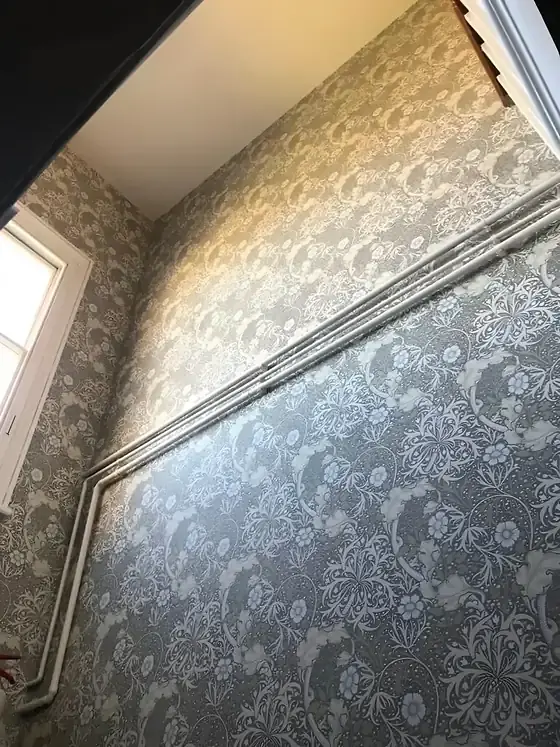
Period rooms need protecting while the ceiling is done. In a central Cambridge house, our team kept a William Morris wallpaper safe while the master plasterer worked on the ceiling above it.
Water stains and ceilings after a leak
A ceiling marked by a leak from a bath or the roof often only needs the stain sealing. Once the leak is fixed and the plaster has dried out, a Zinsser stain block stops the brown ring bleeding through the new emulsion.
If the water has softened or blown the plaster, the damaged area is cut back and replastered, and sometimes the whole ceiling is skimmed so the repair doesn't show. If you're claiming on your insurance, our water damage redecoration page explains how that works.
After the skim: drying, sanding and the first coat
You can watch new plaster dry. The ceiling turns from dark pink to an even pale pink, and any darker patches that linger are still wet. How long that takes depends on the thickness, the room and the weather, so the decorating date is set once the plaster can be seen drying.
On a ceiling, the thinned mist coat also works as an inspection coat. With light coming across from the window, trowel marks and nibs show up, and they're sanded out with a Mirka dust-free sander before the two finishing coats. Our page on decorating new plaster goes into more detail.
Price factors for skimming a ceiling
No two ceilings cost the same to put right. The main factors are:
- Ceiling area and room height, including stairwells that need staging
- Condition: a sound painted ceiling versus loose lath and plaster
- Repairs before skimming, such as cutting out blown patches or overboarding
- Coving, cornice or a ceiling rose to work round
- Light fittings, downlights and alarms
- Painting after the skim, and the colour going on
Plaster and paint on one quotation
Graham prices the plastering and the painting together, so the written quotation shows the complete ceiling rather than half a job.
Booking a plasterer for your ceiling
Graham will come and look at the ceiling, press on any doubtful areas and check for signs of an old leak. He'll tell you whether he thinks it needs filling, skimming or something more, and the written quotation usually follows by email. You pay when the ceiling is finished and you're happy with it.
One customer who had two ceilings plastered by Lewis, along with some remedial work, wrote on Checkatrade: "Plastering was to a very high standard and lots of helpful advice on decorating given by Graham."
If the walls need attention as well, our plastering service covers re-skims after stripping. Textured Artex ceilings have their own page because of the asbestos testing they need first.