Staircase, door and woodwork staining in Cambridge
Woodwork makes or breaks a decorating job. Fresh walls next to chipped skirtings and yellowed doors never look finished. Our woodwork staining and varnishing work covers everything timber inside the house, from staircases and internal doors to door frames, skirting boards, picture rails, window boards and exposed beams.
Some of it you'll want to show off as natural wood, which means staining, varnishing or oiling. Some you'll want painted, in gloss, satin or eggshell. Graham will talk through the options at the free visit and set out exactly what's included in a written quotation.
Staining staircases and internal doors
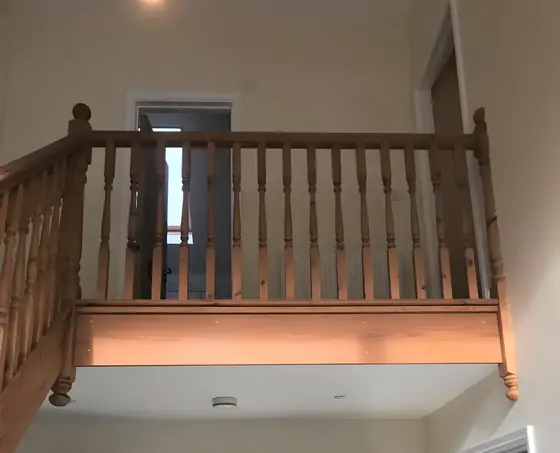
A stained staircase is one of the first things you see when you open the front door. In Fordham, Valter and Denes stained a staircase and doors for Mrs M Turner, who wrote afterwards: “Thank you very much for the amazing transformation, especially the staining on the staircase and doors.” She also described them as exceptionally polite, hardworking and very punctual.
Stairs need careful planning because people still have to use them. We'll agree with you how to keep a route up and down while the work dries. Treads, handrails and spindles all need sanding before stain goes on, so the colour takes evenly and doesn't go blotchy. One of our videos of the team at work shows Josh and Toby preparing a staircase before waxing.
Once the stain is on, a clear protective coat goes over it on areas that take wear, especially the treads and handrail.
Internal doors are taken off their hinges where that helps, or worked on in place with the floor protected. Panelled doors are stained in a set order, panels first and then the rails and stiles, so the colour stays even and there are no dark overlaps where wet edges meet. Handles, hinges and locks are masked or removed so they come back clean.
Varnishing and oiling natural timber
Varnish forms a tough clear layer on the surface, which suits doors, handrails and anything that gets handled. Oil soaks into the wood and hardens inside the grain, which gives a more natural, matt look and is easy to top up later.
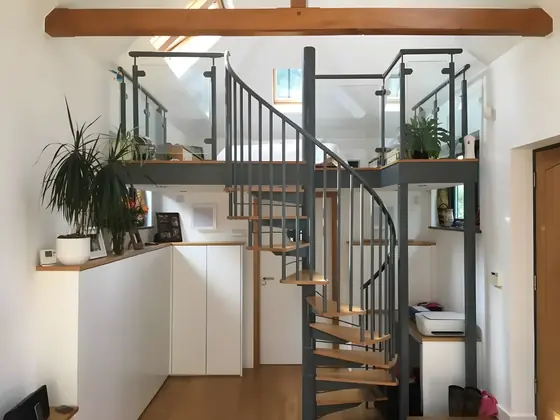
In the Old Telephone Exchange conversion in Fulbourn, we finished the exposed beams and the kitchen worktops with Osmo oil once the walls and trim were painted. Where a kitchen needs more than its worktops refreshed, our page on painting kitchen units explains how we deal with the doors and carcasses.
Beams and other overhead timber often carry decades of dust, old wax or smoke staining, so they're cleaned and sanded before any oil goes on. Working at height on beams also means sheeting the whole floor below and protecting the freshly painted walls alongside. If you have a mix of old and new timber, such as a reclaimed beam beside a new oak lintel, we'll test the finish on both, because they rarely take colour the same way.
Gloss, satin and eggshell for painted woodwork
Glossing is still the traditional choice for skirtings and doors in many houses, and it gives a hard, wipeable finish. A lot of customers now prefer the lower sheen of satin or eggshell, which looks more modern and shows fewer imperfections in old, uneven timber.
Woodwork doesn't have to be white. Painting skirtings and doors in the wall colour, or a shade darker, is a popular way to make a room feel calmer. A darker trim can work too: at the Fulbourn conversion, the interior trim was painted in Dulux Night Jewels against white walls.
In a whole-house renovation, we finished the woodwork in Tikkurila white satinwood. In a Cambridge bedroom, the skirtings and door frames went in Farrow & Ball Skimming Stone eggshell to match the walls, a quiet look that makes a small room feel larger.
Priming bare pine before the top coats
Bare pine can't simply be painted. It's absorbent, and knots can bleed resin through the paint and show as yellow-brown patches months later. A good primer seals the timber and blocks the knots first.
In a Farrow & Ball scheme in Cambridge, every window and door frame was bare pine. We primed them with Zinsser, applied a Farrow & Ball mid-tones eggshell undercoat, then finished with two coats of Elephant's Breath eggshell. The same approach works on new doors, new skirtings and timber that has been stripped back.
Period sash windows need a few extra steps, so we've covered them on a separate page about sash window painting.
Picture rails, skirtings and period details
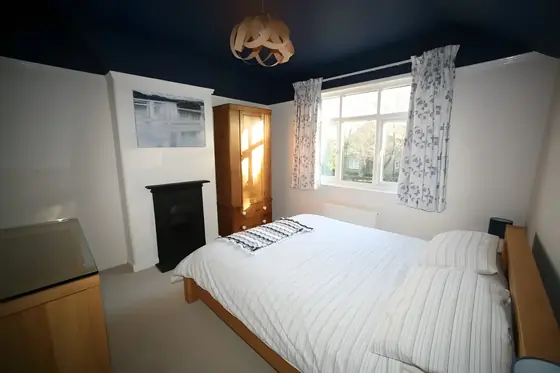
Victorian and Edwardian houses have a lot of woodwork: deep skirtings, picture rails, panelled doors and cupboard fronts. In two bedrooms of a Victorian house in Histon, the picture rails, cupboard doors, door frames and skirtings were all made good, primed, undercoated and finished in white, framing walls in Khaki Mist and a navy ceiling in Sapphire Salute.
Making good on old woodwork means filling dents and gaps, sanding back runs and drips from earlier paint jobs, and dealing with joints that have opened up over the years. We sand with Mirka dust-free sanders, which keeps the rest of the room clean while we work.
We work on period and modern homes across the area, from Victorian terraces in Histon and Impington to family houses in Cherry Hinton.
Preparing woodwork for a lasting finish
Most failures on woodwork come from skipped preparation. Doors are greasy around the handles, skirtings collect dust and polish, and old gloss is too shiny for a new coat to grip. Each needs cleaning and a light sanding before anything goes on.
Gaps where skirtings and architraves meet the wall are filled so the line looks crisp once painted. Old drips and brush marks are sanded out, and dents in door edges are filled and rubbed down. Between coats, we sand lightly again, which is what gives painted woodwork its smooth, even feel.
Natural timber has its own rules. Before staining, the wood has to be sanded evenly, because any patch of old varnish or filler left behind will take the stain differently and show as a pale spot. We test the stain on a hidden area, such as the back of a door or the underside of a tread, so you can approve the colour before it goes on everywhere.