Kitchen cabinet painting in Cambridge instead of a new kitchen
Most of the kitchens we're asked to look at aren't worn out. The carcasses are solid, the doors hang straight and the layout still works for the household. What has dated is the colour, or a finish that has gone yellow and patchy around the handles. Kitchen cabinet painting keeps everything that works and changes how it looks, with no units ripped out, no appliances disconnected and no wait for a fitter.
Graham comes out first to see what the doors are made of, how they were finished before and how much wear the busiest areas have taken. Painted timber, solid wood and MDF doors can all take paint well if they are prepared properly. If a particular door finish is unlikely to hold paint, he'll say so at the visit rather than after we've started.
After the visit you get a written quotation, usually by email, setting out which units, panels and plinths are included, the colour and the finish. We stick to that figure, and anything extra is agreed with you before it's done.
Preparation decides how long the paint lasts
Kitchen doors are handled more than any other painted surface in a house. Cooking leaves a film of grease on doors near the hob and around every handle, and paint will not bond to it however good the paint is. So the first day on a kitchen is mostly cleaning and sanding, and it's the part we never shorten.
- Handles and hinges removed or masked, and doors labelled if they come off so each one goes back in its own place
- Every surface degreased, paying most attention to the doors around the cooker and the bin
- The existing finish sanded with Mirka dust-free sanders to give the new paint something to grip
- Chips and dents filled and sanded flush
- A Zinsser primer chosen to suit the surface underneath
- Worktops, floors, appliances, tiles and walls masked before any paint goes on
Spraying or brushing your kitchen units
We own a Graco Ultra cordless airless handheld sprayer, and you can watch Graham using it in one of our short decorating videos. On plain flat doors and long runs of panels it lays down a very even coat with no brush marks, and it's quick once everything is masked.
When spraying makes sense
Larger kitchens, smooth slab doors and jobs where you want a factory-like finish are the usual candidates. The trade-off is masking: spray mist travels, so every worktop, window, floor and appliance has to be sheeted and taped first. On a big kitchen that time is easily repaid.
When a brush and roller are better
In a small galley kitchen, or one with only a handful of doors, the masking can take longer than the painting. Some people also prefer the slightly hand-finished look of a well-laid-off brush coat on Shaker-style doors. A skilled decorator with a good brush leaves a smooth, tidy finish, and many of our kitchens are done this way or with a mix of the two methods.
Durable paints and colours for cupboard doors
Cupboard doors get wiped, knocked by pans and steamed by kettles, so they need a proper woodwork paint, not wall emulsion. We'll suggest an eggshell or satin finish from makers we use regularly, such as Tikkurila, Farrow & Ball and Dulux. Satin is a little more forgiving to wipe clean, while eggshell has a softer, flatter look that suits period kitchens.
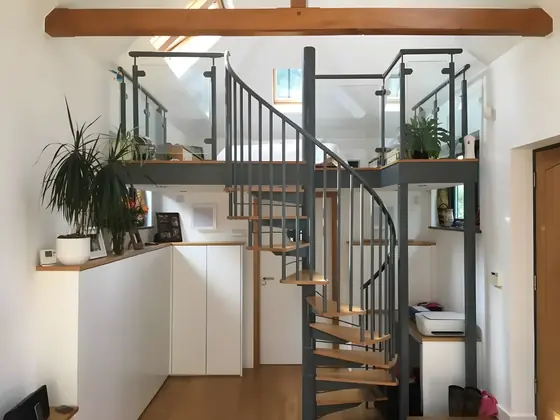
Dark colours are popular on base units and islands, and they look smart against pale walls. In a converted telephone exchange in Fulbourn the interior trim went in Dulux Night Jewels, a deep blue-grey, against white walls. If you're unsure, we can paint test patches on a door so you can see the colour in your own light before committing.
You're welcome to buy the paint yourself if you have a brand in mind. We'd only ask that it's a good-quality woodwork product, because on a kitchen the cheaper tins show it quickly. Paint carries on hardening for a while after it feels dry, so for the first few weeks it's worth treating the doors gently.
Oiling wooden worktops with Osmo
Timber worktops often look as tired as the doors around them. At the Old Telephone Exchange conversion we oiled the kitchen worktops and the exposed beams with Osmo once the decorating was finished, and Valter did a perfect job of it. Oil soaks into the wood rather than sitting on top, so it can be topped up in future without stripping the surface back.
If your worktops are stained or rough, they can be sanded before oiling. Tell Graham at the visit and he'll include it in the quotation, so the units and the tops are finished together.
Built-in wardrobes, bookshelves and fitted furniture
The same process works for built-in wardrobes, alcove shelving, window seats and cupboards under the stairs. A built-in can be painted to match the walls so it almost disappears, or picked out in a contrasting colour to make a feature of it.
Bookshelves take more time than people expect, because every shelf has a top, a front and an underside, and each upright has two faces. We allow for that in the quotation. If a built-in needs altering or repairing before it's painted, such as a sagging shelf or a door that no longer closes, we can bring in our carpenter so the joinery and decorating run as one job.
Painted built-ins sit well alongside other woodwork staining and varnishing, and many customers have doors, skirtings and units refreshed in the same visit as part of wider interior decorating.
Living with the kitchen while we work
Losing the kitchen completely for days isn't practical for most families, so we plan the order of work with you. We'll agree which runs of units are done when, keep the sink and fridge reachable where we can, and clear up at the end of every day.
We're based in Landbeach, a few miles north of the city, so homes in Histon and Impington and nearby Chesterton are a short drive away, as is Fulbourn to the east. Belinda organises the booking and keeps you up to date, and Graham checks the finished kitchen with you at the end.