Sash window painting and restoration for older Cambridge homes
Plenty of the Victorian and Edwardian houses in and around Cambridge still have their original timber sash and case windows. They were built to last, but they only do so while the paint keeps water out of the wood. Once the paint cracks, rain gets into the joints and the bottom rails, and the damage speeds up.
Our sash window painting and restoration is decorative work: careful preparation, repair-filling and painting with the right primers and finishes. It's the part of window care that keeps the timber protected and the house looking as it should. Where a window needs joinery, such as new timber or a replacement sash, we can bring in our carpenter so you still deal with one company.
What Graham checks before he quotes
Every window is different, even in the same house. The ones facing the weather usually need far more work than those on a sheltered side. At the free visit Graham looks at each window and notes what it needs, so the quotation reflects the real condition rather than a guess.
- Flaking, blistered or cracked paint, inside and out
- Bare timber where the paint has gone completely
- Open joints and cracks in the frame, sills and bottom rails
- Soft or rotten patches that need a carpenter rather than filler
- Cracked or loose glazing putty
- Sashes painted shut or catching in the frame
A quotation window by window
Because condition varies so much, the written quotation lists the windows and the work each one needs. If you'd like to spread the cost, it's easy to see which windows are most urgent and start with those, leaving the sheltered ones for another year. We stick to the figure we quote, and if we uncover something unexpected once the old paint is off, we'll show you and agree any extra before doing it.
Preparing period windows the right way
Loose and flaking paint is scraped back to a sound edge, then the surface is sanded so the old and new layers blend without a ridge. We use Mirka dust-free sanders for this. Period windows can carry many layers of old paint, and some older paints contain lead, so keeping dust out of the room matters as much as getting a smooth surface.
Cracks, dents and open joints are filled and sanded flush. Any bare timber is primed before anything else goes on, because paint applied straight onto bare wood soaks in unevenly and won't protect it for long. In a Farrow & Ball redecoration in Cambridge, every window and door frame was bare pine. We primed them with Zinsser, applied a Farrow & Ball mid-tones eggshell undercoat, then finished with two coats of Elephant's Breath eggshell.
Sills and bottom rails get the most attention. They catch standing water, so any crack there is filled and sealed with extra care, and the end grain is primed thoroughly. Between coats, each layer is lightly sanded so the next one goes on smooth rather than building up texture.
Painting sashes so they still open and close
A badly painted sash window looks fine for a week and then sticks. Paint builds up in the runners and on the edges where the sashes pass each other, and eventually the window won't move. We work the sashes up and down during the job so every face gets painted, while keeping paint thin or off the surfaces that need to slide.
On the glass side, a neat line of paint just onto the pane seals the putty against rain. Getting that line straight on dozens of small panes is slow, careful work, and it's one of the things that separates a decorator who knows windows from one who doesn't.
Inside and outside faces
We can paint the inside, the outside or both. Outside faces need an exterior-grade product and dry weather, so if you'd like the whole window done we'll plan the outside for a settled spell and can combine it with wider exterior painting of the house.
Finishes and colours for sash windows
Eggshell and satin are the usual finishes for period windows. Both have a soft sheen that looks right on old timber and is easy to wipe. White and off-white are classic, but coloured windows can look wonderful inside a room.
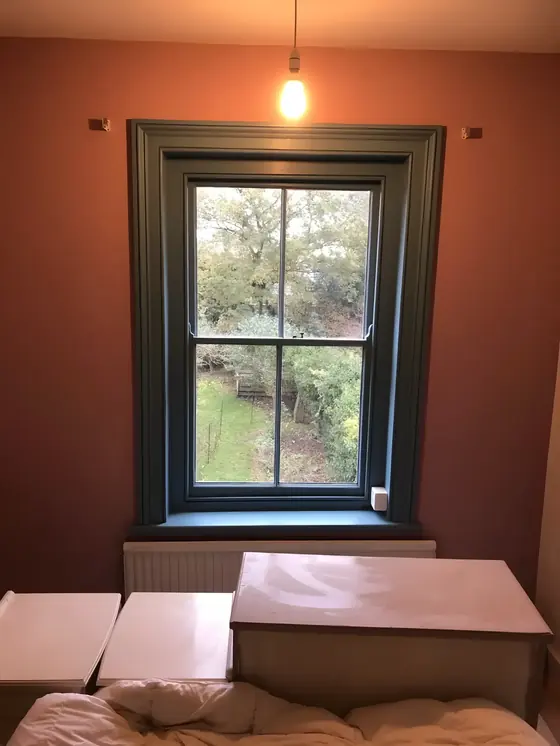
In a Cambridge bedroom we stripped and skimmed, the window was painted in Fired Earth Turkish Blue eggshell, set against walls in Farrow & Ball Skimming Stone, with skirtings and door frames in Skimming Stone eggshell. If you'd like to do something similar, we'll paint test patches on the frame so you can judge the colour in daylight and in the evening.
Outside, most people keep to white or a soft off-white so the windows match the rest of the street, though darker greys and greens suit some houses well. If you live in a conservation area or a listed building, it's worth checking whether there are any rules about window colours before choosing.
When a window needs more than paint
Paint can't fix rotten timber, broken sash cords or a window that rattles in the wind. If Graham finds problems like these, he'll explain what he's seen and we can bring in our carpenter to deal with them before we decorate. That way the repair and the paintwork are planned together and the finish isn't spoilt by a second trade arriving afterwards.
Doors, skirtings and other period joinery often need the same attention as the windows, and our page on staining, varnishing and glossing woodwork covers those.
Keeping your home secure while we work
We plan the work so windows can be shut and fastened at the end of each day. Freshly painted sashes are eased before we leave so they don't set closed overnight.
Inside the room, we sheet the floor and any furniture near the window, and the curtains or blinds are taken down and put somewhere safe. If you have shutters in the window reveals, they can be decorated at the same time. Every evening the room is left tidy, and at the end Graham walks round the windows with you to check each one opens, closes and looks right.
We're based in Landbeach and work on period houses across the area, including Victorian homes in Histon and Impington and the older streets of Chesterton, as well as cottages and larger houses around Grantchester.