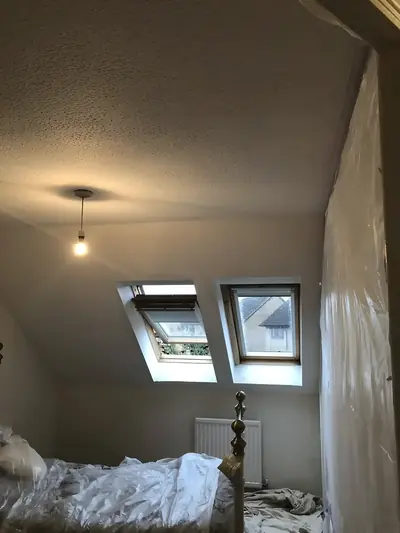
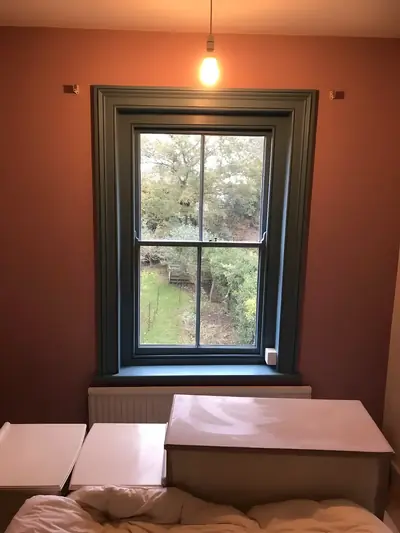
Skimming over Artex in Sawston
Council Tax records count 300 Sawston homes from 1945 to 1954, 540 from 1955 to 1964, and more than 1,100 from 1965 to 1982. Houses from those years very often still have a swirled or stippled ceiling in the lounge, hall or bedrooms.
Lewis, our plasterer, skims over the texture so the ceiling is smooth and ready for paint. It is usually far less disruptive than taking the ceiling down. We sheet the room, remove fittings and prepare the surface so the plaster bonds.
Cracks, older walls and coving
Ceilings in houses of this age can crack along the joints between boards. Hairlines can be filled, but deeper or recurring cracks may point to movement or a leak, and we will tell you if we think so. Water marks get a Zinsser stain block.
In the couple of hundred Sawston homes built before 1919, walls may be lath and plaster or older lime, and stripping paper can expose problems. We can also hang new coving once the ceiling is skimmed. Plastering and interior decorating go on one quotation.
Textured ceilings in Sawston: test first, then skim
Nearly nine in ten Sawston properties are old enough for the asbestos question to matter: Council Tax records date 88.9% of them to before 2000. Health and Safety Executive guidance is that textured coatings like Artex, in buildings built or refurbished before that date, may contain asbestos. You can't tell by looking, so a sample should be tested before anyone sands, scrapes or drills a textured ceiling, even to take down a light fitting.
One Checkatrade review from the CB22 postcode district, which takes in Sawston and nearby villages, is headed “Re-skimmed cracked ceiling (covering artex). Cut and filled numerous wall cracks and made good decoration.” The customer, writing in January 2020, said: “Very quick and neat work. Very professional. Time-keeping was perfect.” The review doesn't say which village the house was in, so we can't claim it for Sawston.
Older and listed houses need a different conversation. Lime plaster in a pre-1919 cottage isn't the same job as skimming a post-war ceiling, and Graham will tell you honestly at the visit whether it's work we can take on. If your home is one of the parish's 45 list entries, check with the council before any plaster is repaired or replaced; the consent note below has the links.
Figures from Valuation Office Agency Council Tax stock by build period; Historic England's National Heritage List. Contains public sector information licensed under the Open Government Licence v3.0. © Crown Copyright 2026. Contains Ordnance Survey data © Crown copyright and database right 2026. Released under OGL.
Sawston at a glance
- 10 milesfrom our Landbeach base in a straight line, about 24 minutes by roadOSRM routing
- 27%were built 1945 to 1964VOA Council Tax stock
- 38%were built 1965 to 1982VOA Council Tax stock
- 7%of properties were built before 1919VOA Council Tax stock
- 3,057householdsCensus 2021
- 4%date from 1919 to 1939VOA Council Tax stock
Sources: Census 2021 for Sawston parish (ONS); Council Tax: stock of properties, 2026; road distance by OSRM.
Listed buildings: check before plastering
In a listed Sawston home, talk to South Cambridgeshire District Council's planning service before old plaster is repaired, replaced or skimmed over. Its listed buildings page says that consent “is required for any work that affects the character of the building including alterations, extensions and demolition”, and the council's Listed Buildings SPD and listed buildings leaflet are linked here.
Listed buildings, Greater Cambridge Shared Planning · Listed Buildings SPD (PDF) · Listed buildings leaflet (PDF)
How we approach plastering
For a textured ceiling in a Sawston house, nothing is disturbed until the test result is back. Once it's clear, the room is emptied or the furniture grouped and sheeted, light fittings come down (by an electrician where needed), sharp peaks are knocked back and a bonding primer goes on so the new plaster grips. Lewis then skims; once the plaster has dried out fully we sand off nibs with Mirka dust-free sanders, apply a thinned mist coat to show any dips, fill and spot-sand, and finish with two coats. Each step and the products we use are explained on our plastering page, with answers to common questions.