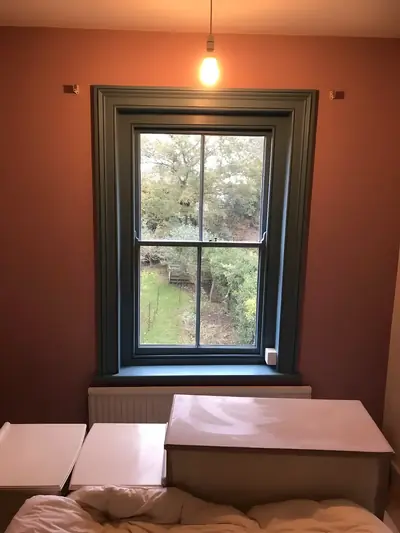
Period windows in a post-war village
Most local houses date from after 1945, so the period windows that do survive tend to be in the older village core. In the conservation area, keeping original timber windows in good order matters for the look of the street, and it is often easier than replacing them.
We scrape loose paint back to a sound edge, fill cracks and open joints, prime any bare wood and finish in eggshell or satin. Water sits longest on the sills and bottom rails, so those are filled and primed with particular care.
Joinery and colour
Rotten timber, broken cords and rattling sashes are carpentry. Our carpenter handles them, and we plan the repair and the painting together so the job runs as one.
Our Sawston exterior painting page covers the rest of the outside.
Where period windows survive in Sawston
Timber sashes belong to a small share of Sawston's homes. Council Tax records date 6.7% of the parish's properties to before 1919, against 11.2% across South Cambridgeshire and 20.0% across England. Where original windows do survive, they are usually worth keeping: water gets into the joints and bottom rails once the paint cracks, and regular repainting is what keeps the timber sound.
Seven of the parish's list entries are numbered High Street addresses, including 54, High Street, listed in 1986, and 84, High Street, listed in 1974. If your house is one of those, or another of Sawston's 45 entries, talk to the council before changing frames, glazing or the colour of the windows.
On windows painted before the 1960s, the lower layers may contain lead, so they should be tested before anyone sands them, and never sanded dry. Our Mirka dust-free sanders extract at the pad, which keeps old paint dust out of the room while the frames are prepared.
Figures from Valuation Office Agency Council Tax stock by build period; Met Office 1991-2020 climate averages; Historic England's National Heritage List; Historic England conservation areas. Contains public sector information licensed under the Open Government Licence v3.0. © Crown Copyright 2026. Contains Ordnance Survey data © Crown copyright and database right 2026. Released under OGL. © Historic England and Local Planning Authorities 2026.
Sawston at a glance
- 10 milesfrom our Landbeach base in a straight line, about 24 minutes by roadOSRM routing
- 7%of properties were built before 1919VOA Council Tax stock
- 45listed buildingsHistoric England
- 1conservation areaHistoric England
- 23%are terracedCensus 2021
- 4%date from 1919 to 1939VOA Council Tax stock
Sources: Census 2021 for Sawston parish (ONS); Council Tax: stock of properties, 2026; Historic England listed buildings; Historic England conservation areas; road distance by OSRM.
Listed buildings and conservation areas in Sawston
- Sawston HallGrade I listed
- Queen's Head InnGrade II* listed
- Parish Church of St MaryGrade I listed
- SawstonConservation area
Sources: Historic England listed buildings; Historic England conservation areas.
Planning: check before you change a window
If your Sawston house is listed, speak to South Cambridgeshire District Council's planning service, Greater Cambridge Shared Planning, before changing window frames, glazing or paint colour. The council's listed buildings page also warns: “It is a criminal offence to carry out unauthorised work to a listed building.” Its Listed Buildings SPD and the boundary map for the Sawston Conservation Area are linked below.
Listed building consent, council guidance · Listed Buildings SPD (PDF) · Listed buildings leaflet (PDF) · Sawston Conservation Area boundary map (PDF)
How we approach sash window restoration
On a Sawston sash, Graham notes each window separately at the visit, inside and out, and marks the ones facing the weather. Paint that may contain lead is tested first. Loose paint is scraped back to a firm edge and sanded with Mirka dust-free sanders, open joints and sills are filled, bare timber gets a Zinsser primer, and failed putty is made good before eggshell or satin. Paint is kept thin on the sliding faces, and every sash is run up and down before the room is left. Our sash window restoration page sets out each step, the products we use and the questions people ask most.
Best time of year for the work
Outside faces need settled, frost-free weather. At the Met Office's Cambridge NIAB station, about 9 miles north of Sawston, the 1991-2020 averages add up to about 36 days of air frost between November and March, and April still averages 2.6 days, with an April air frost in 24 of the 30 years. We aim to paint the outside of sashes from May to September and leave the inside faces for the colder months.