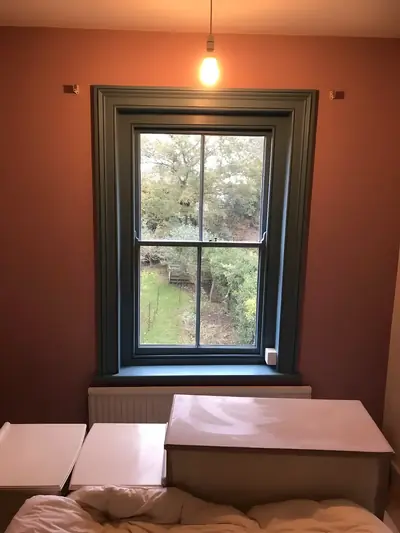
Painting sash windows in Melbourn
The weather side of a house usually shows it first: paint cracked at the joints, bare timber on the bottom rail and putty coming loose. Graham notes each window's condition at the visit, so your written quotation lists them one by one and you can start with the worst.
We scrape back to a sound edge, sand with Mirka dust-free sanders to keep old paint dust contained, fill cracks and open joints, prime bare wood and finish in eggshell or satin. Sashes are worked up and down so every face is painted without gumming up the runners.
Listed windows and the conservation area
Melbourn's listed buildings include The Manor House and the Parish Church of All Saints at Grade II*, and 70 at Grade II.
Cords, weights and rotten timber are joinery. Our carpenter deals with those first as part of the same job, and the sash window restoration page has the detail.
Sash window painting on Melbourn's listed streets
Most of Melbourn's list entries that carry a house number sit on just five streets. Of the parish's 72, Historic England's data puts 14 at High Street addresses, three each on Dolphin Lane, Little Lane and The Moor, and two on Rose Lane, among them 59, High Street and 20, Dolphin Lane, both Grade II.
A list entry protects a building; it doesn't describe its windows, and some listed houses keep original timber sashes while others were altered long ago. The same is true of the unlisted period houses, which make up most of the 12.3% of properties in the wider statistical area built before 1919, a little above the 11.2% across South Cambridgeshire. Graham checks every sash at the visit for the usual failures: open joints in the bottom rail and sill, loose putty, soft timber and sashes painted shut.
On a listed house, or inside the Melbourn conservation area, check the note below before a window changes colour.
Figures from Valuation Office Agency Council Tax stock by build period; Met Office 1991-2020 climate averages; Historic England's National Heritage List; Historic England conservation areas. Contains public sector information licensed under the Open Government Licence v3.0. © Crown Copyright 2026. Contains Ordnance Survey data © Crown copyright and database right 2026. Released under OGL. © Historic England and Local Planning Authorities 2026.
Melbourn at a glance
- 14 milesfrom our Landbeach base in a straight line, about 27 minutes by roadOSRM routing
- 12%of properties were built before 1919 (Melbourn and the surrounding area)VOA Council Tax stock
- 72listed buildingsHistoric England
- 1conservation areaHistoric England
- 17%are terracedCensus 2021
- 4%date from 1919 to 1939 (Melbourn and the surrounding area)VOA Council Tax stock
Sources: Census 2021 for Melbourn parish (ONS); Council Tax: stock of properties, 2026, for the statistical areas covering Melbourn and the surrounding area; Historic England listed buildings; Historic England conservation areas; road distance by OSRM.
Listed buildings and conservation areas in Melbourn
- The Manor HouseGrade II* listed
- Parish Church of All SaintsGrade II* listed
- 10, 12, Mortlock StreetGrade II listed
- MelbournConservation area
Sources: Historic England listed buildings; Historic England conservation areas.
Planning: check before you change a window
On a listed house, ask South Cambridgeshire District Council before window colours, glazing or joinery details change: its listed buildings page says listed building consent is required for any work that affects the character of the building. For an unlisted house inside the Melbourn conservation area, the council says some works may need planning permission that otherwise wouldn't. Melbourn wasn't among the places on the council's Article 4 register when it was checked in October 2026, though the register isn't presented as complete.
Listed building consent, Greater Cambridge Shared Planning · Listed buildings leaflet (PDF) · Melbourn Conservation Area Appraisal 2021 (PDF)
How we approach sash window restoration
For a Melbourn house with original sashes, the windows are taken one at a time: loose paint scraped back to a sound edge, the surface sanded with Mirka dust-free sanders to keep old paint dust contained, cracks and open joints filled, and bare timber primed, with extra primer on sills and end grain. Where cords or timber have failed, our carpenter repairs them first. The putty is sealed with a fine painted line on the glass, and sashes are run up and down during the job so they still slide when the house is locked up.
If the windows were first painted before the 1960s, the lower layers may contain lead: they are tested before work starts, and positive paint is never sanded dry or burnt off.
Best time of year for the work
The inside of a sash can be done in winter. Outside faces need settled, dry days: at the Met Office's Cambridge NIAB station, about 12 miles north of Melbourn, September averaged 144 hours of sunshine and about 8 days with rain in 1991-2020, with no air frost from June to September, so late summer into September is a good spell for the outside, with the exact days chosen from the forecast.