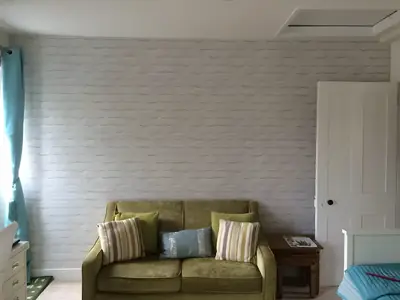
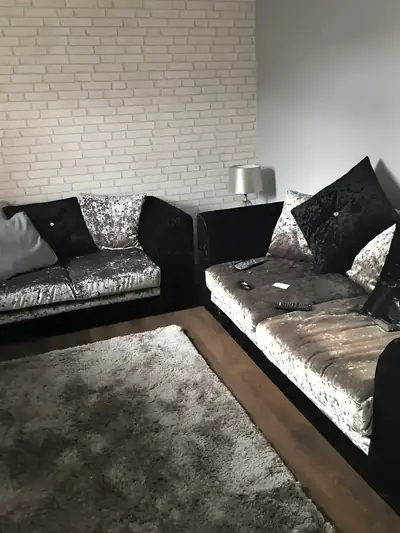
Wallpaper hanging on Melbourn's older walls
Old lime and sand plaster moves, patches and dips. Hung straight onto it, a smooth paper shows every flaw, so we usually line the wall first and let the finish paper dry onto an even surface.
Heritage and designer papers leave little room for waste. Simon, our specialist, checks batch numbers, plans where the pattern will fall and finds the least visible spot for the final join before cutting. We did this through three storeys of William Morris paper in a central Cambridge hall and stairwell.
Newer houses and feature walls
About a quarter of the homes in and around the village date from 2000 or later, and those walls are a simpler job: fill, size and hang. A single feature wall in a bedroom or dining room is the usual starting point, and we can hold samples up in the room so you can judge the scale of the pattern.
If your home is listed, check with South Cambridgeshire District Council before removing historic wall finishes.
Wallpaper hanging in Melbourn: old cottage plaster and post-war walls
Council Tax build dates aren't published for Melbourn on its own, so the nearest guide is the three statistical areas that hold all of its households, plus some outside it. In that wider statistical area, 340 properties predate 1919 and only 100 come from 1919-39; most of the rest were built after the war. That gives a paperhanger two quite different kinds of wall to deal with.
In a house built since the war, the walls are usually flatter, and the work is in what previous owners have put on them: layers of old paper, some of it painted over, and holes from shelves and fixings. We strip back to the plaster, wash off the old paste, fill and size, and then most papers can go straight up, including the non-woven kinds that are pasted on the wall instead of the table.
Walls in the older cottages are the opposite case, because there the plaster itself is the issue: soft, patched and rarely flat, so lining paper usually goes up first to give the finish paper an even surface. Among the parish's 72 list entries, 8 are named as cottages, including Cherry Tree Cottage, Grade II.
Figures from Valuation Office Agency Council Tax stock by build period; Historic England's National Heritage List. Contains public sector information licensed under the Open Government Licence v3.0. © Crown Copyright 2026. Contains Ordnance Survey data © Crown copyright and database right 2026. Released under OGL.
Melbourn at a glance
- 14 milesfrom our Landbeach base in a straight line, about 27 minutes by roadOSRM routing
- 12%of properties were built before 1919 (Melbourn and the surrounding area)VOA Council Tax stock
- 4%date from 1919 to 1939 (Melbourn and the surrounding area)VOA Council Tax stock
- 2,143householdsCensus 2021
- 72listed buildingsHistoric England
- 69%of homes are owner-occupiedCensus 2021
Sources: Census 2021 for Melbourn parish (ONS); Council Tax: stock of properties, 2026, for the statistical areas covering Melbourn and the surrounding area; Historic England listed buildings; road distance by OSRM.
Listed buildings and conservation areas in Melbourn
- The Manor HouseGrade II* listed
- Parish Church of All SaintsGrade II* listed
- 10, 12, Mortlock StreetGrade II listed
- MelbournConservation area
Sources: Historic England listed buildings; Historic England conservation areas.
How we approach wallpapering
Before quoting for a Melbourn cottage, Graham lifts a corner of the old paper to see how it comes away and what state the plaster is in, so any repair by our plasterer is in the written quotation from the start. In the post-war houses, walls are stripped, washed down, filled and sized. Either way the pattern is set out from the wall you see first as you walk in, every length is checked against a plumb line, and the final join is planned for the least visible corner. For the full method and the products we use, see our wallpapering page.