
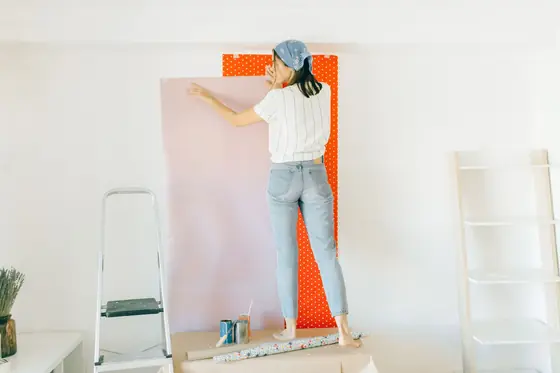
Smooth walls in newer homes
Around 2,260 Royston homes date from 2000 onwards, by Council Tax records. Walls in those houses are usually flat plasterboard, which suits non-woven papers hung by pasting the wall. The main preparation is sizing or priming the board as the paper maker recommends.
A feature wall is the most common request in houses like these: behind a bed, across a chimney breast or on the wall you see as you walk in. We'll hold samples up in the room so you can judge the scale of the pattern.
Older walls and listed houses
Only about 10% of homes predate 1919, and interwar houses are rarer still at around 3%. In those older rooms we usually strip, fill and cross-line before hanging, because the walls are rarely true. If you live in one of the listed buildings, check with North Hertfordshire District Council before removing any historic wall finish.
For heritage designs, Simon, our wallpaper specialist, sets out the pattern before anything is cut, as he did on a William Morris staircase over three floors in Cambridge. If stripping reveals loose plaster, our plastering team can skim before papering.
Royston at a glance
- 22 milesby road from our Landbeach base, about 32 minutesOSRM routing
- 10%of properties were built before 1919VOA Council Tax stock
- 3%date from 1919 to 1939VOA Council Tax stock
- 7,489householdsCensus 2021
- 116listed buildingsHistoric England
- 71%of homes are owner-occupiedCensus 2021
How we approach wallpapering
We'd check the walls, strip any old paper and wash off paste residue, then fill and sand. Older walls are cross-lined; new plasterboard is sized. The finish paper is hung from a plumb line, with batch numbers checked and the pattern centred on the focal wall. We tidy every day and walk round the room with you at the end. The full method, products and FAQs are on our wallpapering page.