
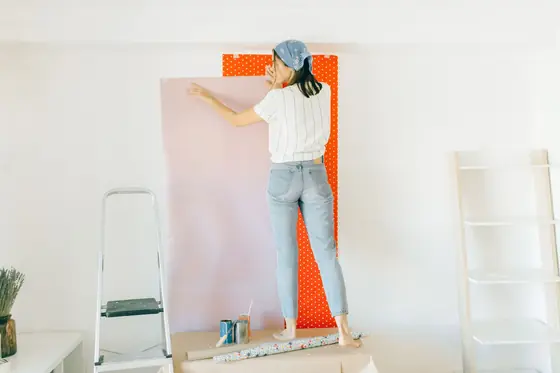
Older walls and lining paper
Of roughly 1,220 pre-war homes, about 430 date from before 1919. Plaster in houses like these has often been patched over decades, and stripping old paper can bring loose areas away. We make good, and if a wall needs more, our plasterers can skim it before the paper goes up, with any extra cost agreed first.
Lining paper evens out the surface so a heavy or hand-printed paper dries flat. It's especially worth it on chimney breasts and stair walls, where raking light shows every ripple.
Heritage papers and listed rooms
Baldock has 104 listed buildings and a conservation area, and heritage designs such as William Morris suit period rooms well. We check batch numbers, plan where the pattern falls and find the least visible join before cutting a roll. Our William Morris staircase project in Cambridge shows that process over three floors.
Two thirds of households own their home, and many want one striking wall rather than a whole room. We'll hold samples up in place so you can judge the pattern's scale first.
Baldock at a glance
- 30 milesby road from our Landbeach base, about 40 minutesOSRM routing
- 9%of properties were built before 1919VOA Council Tax stock
- 16%date from 1919 to 1939VOA Council Tax stock
- 4,680householdsCensus 2021
- 104listed buildingsHistoric England
- 66%of homes are owner-occupiedCensus 2021
How we approach wallpapering
In an older Baldock room we strip every layer, wash off the old paste and fill, then line the walls, letting the lining dry before the finish paper. Patterns are set out from the main wall, and each drop is checked with a plumb line. Newer walls from the 1980s onwards usually just need sizing before hanging. The full method, products and FAQs are on our wallpapering page.