
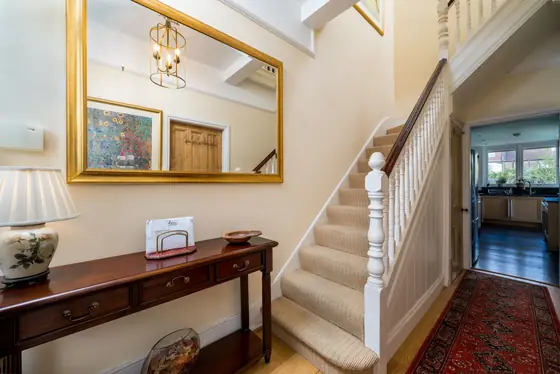
Staining stairs and doors
A stained staircase is the first thing you see from the front door. Treads, handrails and spindles are sanded first so the stain takes evenly, then a clear protective coat goes on where hands and feet wear it. We test the colour on the underside of a tread before going further.
Panelled doors are stained panels first, then rails and stiles, so wet edges don't leave dark overlaps. In Fordham, Valter and Denes stained a staircase and doors for a customer who thanked us for the amazing transformation.
Painted joinery in Baldock's older homes
With 104 listed buildings and a conservation area, Baldock has plenty of joinery that deserves a finish in keeping. Eggshell and satin have a softer sheen than gloss and show fewer marks on old timber. Bare pine is primed with Zinsser first so knots don't bleed through.
Doors and skirtings in the wall colour, or a shade darker, make a room feel calmer. For the walls themselves, see interior decorating in Baldock.
Baldock at a glance
- 30 milesby road from our Landbeach base, about 40 minutesOSRM routing
- 9%of properties were built before 1919VOA Council Tax stock
- 16%date from 1919 to 1939VOA Council Tax stock
- 79%are houses rather than flatsCensus 2021
- 104listed buildingsHistoric England
- 66%of homes are owner-occupiedCensus 2021
How we approach woodwork staining & varnishing
Each Baldock job starts with cleaning: grease off door edges, dust and polish off skirtings. Old gloss is sanded to a key, runs and drips rubbed out, and gaps along the wall filled. Natural timber is sanded evenly so no patch of old varnish shows pale under the stain. Painted work gets an undercoat and top coats, lightly sanded between. The full method, products and FAQs are on our woodwork staining & varnishing page.