
Period joinery in the old town
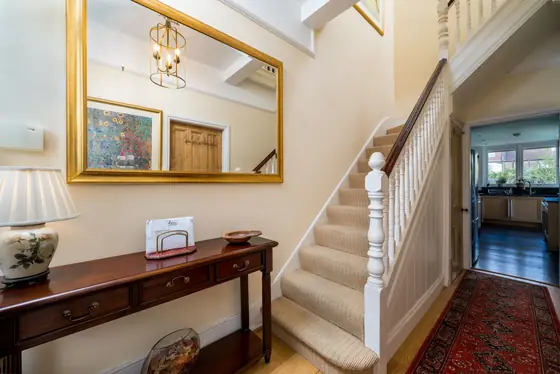
Older timber in the 330 or so pre-1919 homes often has generations of paint, dents and open joints. We fill and sand those back, prime bare patches and finish in eggshell, which suits uneven old wood. For stained stairs and doors, the timber is sanded evenly so the colour takes without patches, and tested on a hidden area first.
In Fordham, Valter and Denes stained a staircase and doors for Mrs M Turner, who singled out that staining in her review on our reviews page.
Doors and skirtings in newer houses
With nearly 40% of Buntingford homes built since 2000, a lot of the woodwork here is newer softwood. Bare pine is primed with Zinsser to stop knots bleeding through, then given satin or eggshell. Painting skirtings in the wall colour, or a shade deeper, is a popular modern look. Where a new staircase has a plain varnish that has worn on the treads, we sand it back evenly and recoat it so the colour stays consistent from top to bottom.
Buntingford at a glance
- 31 milesby road from our Landbeach base, about 43 minutesOSRM routing
- 10%of properties were built before 1919VOA Council Tax stock
- 4%date from 1919 to 1939VOA Council Tax stock
- 89%are houses rather than flatsCensus 2021
- 98listed buildingsHistoric England
- 75%of homes are owner-occupiedCensus 2021
How we approach woodwork staining & varnishing
Doors, frames and skirtings are washed to remove grease and polish, then sanded so the new coat can grip. Gaps where skirtings and architraves meet the wall are filled for a crisp line. Panelled doors are coated panels first, then rails and stiles. Beams and worktops are oiled with Osmo, and stained treads get a clear protective coat. The full method, products and FAQs are on our woodwork staining & varnishing page.