
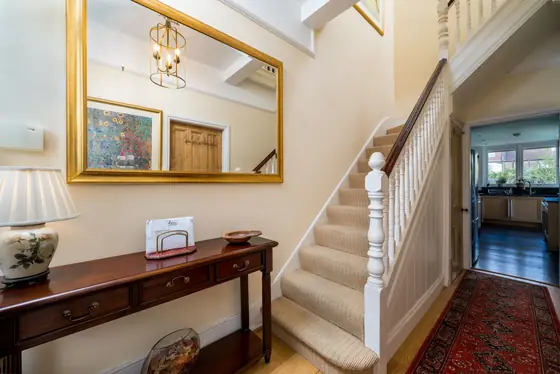
Period staircases and doors
Older houses here tend to have deep skirtings, picture rails, panelled doors and staircases with turned spindles, often under layers of old gloss. We fill dents, sand back drips and open joints with Mirka dust-free sanders, then repaint in eggshell or satin, or stain and varnish where the timber is worth showing. Panelled doors are stained panels first, then rails and stiles, so the colour stays even.
If your home is one of the town's 331 Grade II listed buildings, ask Uttlesford District Council before stripping original finishes.
Newer woodwork in Saffron Walden
Around 1,560 homes in the parish were built since 2009. Their softwood skirtings and doors often need little more than a light sand and fresh satin, though bare pine should be primed with Zinsser first so knots don't bleed through, as we did in a Farrow & Ball redecoration in Cambridge.
In Fordham, Valter and Denes stained a staircase and doors for Mrs M Turner, who wrote that they were exceptionally polite, hardworking and very punctual. You can read more on our reviews page.
Saffron Walden at a glance
- 25 milesby road from our Landbeach base, about 33 minutesOSRM routing
- 14%of properties were built before 1919VOA Council Tax stock
- 6%date from 1919 to 1939VOA Council Tax stock
- 80%are houses rather than flatsCensus 2021
- 373listed buildingsHistoric England
- 65%of homes are owner-occupiedCensus 2021
How we approach woodwork staining & varnishing
On a Saffron Walden staircase we protect the floor and walls, clean off old polish and grime, then sand treads, spindles and handrail evenly. Stain is tested on the underside of a tread before it goes on everywhere, then a clear protective coat follows on areas that take wear. Painted joinery is primed, undercoated and finished in eggshell or satin. The full method, products and FAQs are on our woodwork staining & varnishing page.