
Woodwork staining and varnishing in Linton
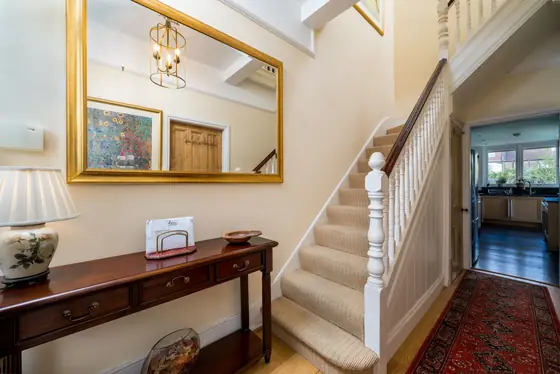
Stairs are the piece most people notice first. We sand treads, spindles and handrails evenly so stain takes without blotches, keep a route up and down while it dries, and finish wear areas with a clear protective coat. In Fordham, Valter and Denes did this kind of job for Mrs M Turner.
Panelled doors are stained panels first, then rails and stiles, to avoid dark overlaps where wet edges meet.
Paint, oil and period details
Many owners now prefer satin or eggshell to gloss on skirtings and doors, because the lower sheen shows fewer imperfections on old, uneven timber. Bare pine is primed with Zinsser so knots don't bleed through, as on the frames in our Farrow & Ball redecoration.
Beams and timber worktops can be oiled with Osmo. In a listed house, check before altering finishes on original joinery.
Linton at a glance
- 20 milesby road from our Landbeach base, about 26 minutesOSRM routing
- 15%of properties were built before 1919VOA Council Tax stock
- 4%date from 1919 to 1939VOA Council Tax stock
- 94%are houses rather than flatsCensus 2021
- 125listed buildingsHistoric England
- 70%of homes are owner-occupiedCensus 2021
How we approach woodwork staining & varnishing
Before staining we sand to an even surface so old varnish or filler doesn't show as a pale patch, then test the colour on a hidden area such as the back of a door. Painted woodwork is cleaned, keyed and filled, gaps along skirtings are caulked, and we sand lightly between coats for a smooth finish. The full method, products and FAQs are on our woodwork staining & varnishing page.