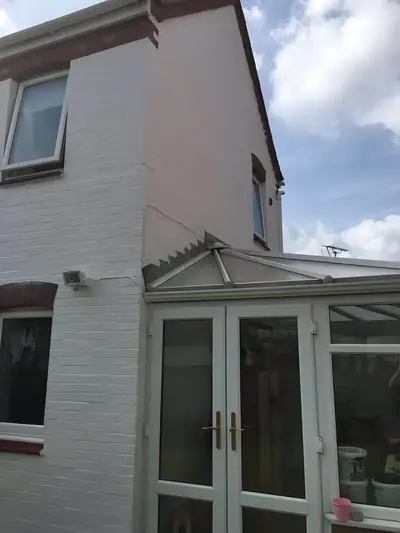
Exterior house painting in Linton
Semis make up 43.3% of Linton homes. On a semi, your half sits right beside your neighbour's, so we can paint test patches on a discreet section to see how a colour reads next door in daylight.
We clean with an anti-fungal jet wash, scrape back loose paint, repair masonry and render, and use breathable masonry paint so moisture can escape the wall. Exterior timber gets primer, undercoat and top coat.
Colour choices and the Linton conservation area
Linton's conservation area and its 125 listed buildings mean exterior colour may need more thought here than in a newer village. Graham will also tell you honestly when bare facing brick is better left unpainted.
Fascias, soffits, gutters and downpipes are usually done together.
Detached sales, listed streets and the conservation area: painting outside in Linton
Detached houses changed hands more than any other type in Linton. HM Land Registry recorded 69 detached sales among the 141 between August 2024 and July 2026, 48.9% of the total, at a median of £570,000. Four elevations mean four lots of access to plan, from a narrow side passage to the wall above a conservatory roof, and the written quotation covers each wall along with the fascias, soffits, gutters and sills.
Where the house stands matters as much as its shape. The Linton Conservation Area has a 2022 appraisal and its own boundary map, and the parish's list entries include houses such as 38, High Street and 16, The Grip, both Grade II, with four entries named by a house number on The Grip alone. If your house is listed or inside the boundary, settle the colour question with the council first, using the links in the note below.
Most Linton homes are post-war, though: 81.0% were built in 1945 or later. On those the usual list is fascias, soffits and bargeboards cleaned, sanded and recoated, cracks in render filled, and walls washed with an anti-fungal solution before the masonry paint goes on.
Figures from Valuation Office Agency Council Tax stock by build period; HM Land Registry Price Paid Data; Met Office 1991-2020 climate averages; Historic England's National Heritage List; Historic England conservation areas. Contains public sector information licensed under the Open Government Licence v3.0. Contains HM Land Registry data © Crown copyright and database right 2021. This data is licensed under the Open Government Licence v3.0. © Crown Copyright 2026. Contains Ordnance Survey data © Crown copyright and database right 2026. Released under OGL. © Historic England and Local Planning Authorities 2026.
Linton at a glance
- 13 milesfrom our Landbeach base in a straight line, about 26 minutes by roadOSRM routing
- 94%are houses rather than flatsCensus 2021
- 34%of homes are detachedCensus 2021
- 15%of properties were built before 1919VOA Council Tax stock
- 1conservation areaHistoric England
- 16%were built 1945 to 1964VOA Council Tax stock
Sources: Census 2021 for Linton parish (ONS); Council Tax: stock of properties, 2026; Historic England conservation areas; road distance by OSRM.
Listed buildings and conservation areas in Linton
- 1 and 3, Coles LaneGrade II* listed
- 87 and 89, High StreetGrade II* listed
- Queens HouseGrade II* listed
- LintonConservation area
Sources: Historic England listed buildings; Historic England conservation areas.
Planning: check before you change colours
If your house is listed or inside the Linton Conservation Area, ask South Cambridgeshire District Council before changing its outside colour. The council's conservation areas page says that within a conservation area you may need planning permission for some works which would otherwise not need permission, and its listed buildings page says consent is required for any work that affects the character of the building. Linton is not among the places named on the council's register of Article 4 directions (checked October 2026), though the council doesn't present that register as a complete list.
Linton Conservation Area boundary map · Linton Conservation Area Appraisal 2022 · Council page on conservation areas · Council page on listed buildings · Council Article 4 register
How we approach exterior painting
On a Linton house the order is usually fascias and soffits first, then walls, then windows and doors, so any drips fall on surfaces still to be painted. Walls are jet washed with an anti-fungal wash and given time to dry out, bare timber is primed with Zinsser, and two or three colours go on as test patches on a side wall so you can judge them in daylight before the masonry paint is ordered. How we work, step by step, and the questions people usually ask are on our exterior painting page.
Best time of year for the work
At the Met Office's Cambridge NIAB station, about 13 miles north-west of Linton, April averages 38 mm of rain on 1991-2020 figures, but about one April in five gets less than 13 mm and one in five more than 63 mm, and air frost was recorded in April in 24 of the 30 years. So we use April for surveys and repairs where we can, plan most outside coats from May to September, and choose the days themselves from the forecast.