
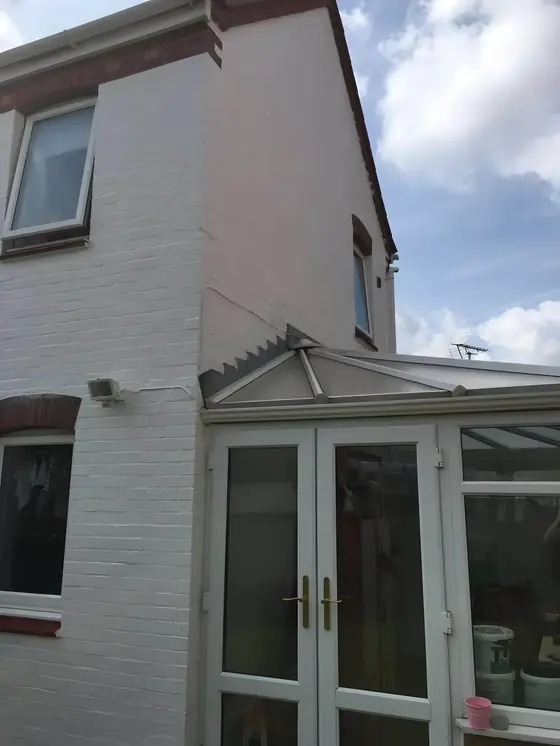
Render painting and masonry painting in Cambridge
Our decorators carry out render painting and masonry painting on houses, bungalows and commercial buildings around Cambridge. That covers smooth sand-and-cement render, pebbledash and roughcast, and masonry walls that have been painted before and are now flaking, faded or green.
Graham surveys every wall himself before quoting. This page goes into the detail of rendered and painted masonry. For the wider picture, including timber and rooflines, see our exterior house painting page. If your walls are bare facing brick, the questions are different, and we cover them on our brick painting page.
Reading the wall before any paint goes on
When exterior wall painting fails early, the cause is usually the wall underneath. So the survey is about finding out what the surface is doing.
Graham taps render to listen for hollow, blown sections that have come away from the masonry behind. Painting over those is wasted money, because they will crack and drop off in time. He looks at whether cracks are fine hairlines in the surface or wider ones that suggest movement, which is a question for a builder before a decorator. He rubs a hand across old paint to see if it comes away as chalky powder, and checks for white salt deposits or damp patches that point to water getting in somewhere.
- Hollow or blown render: cut out and patched by our master builder or plasterer
- Hairline cracks: raked out and filled with a flexible exterior filler
- Chalky old paint: brushed down and sealed with a stabilising solution
- Mould, algae and lichen: treated with an anti-fungal wash and left to dry
- Damp or salt staining: the cause found and dealt with before painting
Smooth render, pebbledash and painted masonry
Each type of wall takes paint differently, and the method changes with it.
Smooth render
Smooth render shows every patch and ridge once it is painted, especially in low sun. Repairs are feathered in so they don't stand proud, and filled areas are spot-primed so they don't flash through the top coats as dull patches. Brand-new render needs time to dry and cure before it is painted, and the paint maker's guidance on waiting times is the one to follow.
Pebbledash painting
Painting pebbledash is slow, thirsty work. Loose stones are brushed off first, and bald patches where the dash has fallen away may need repairing so they don't show as smooth islands in the finished wall. The paint has to be worked into every hollow between the stones, usually with a long-pile roller and a brush behind it, and it uses far more paint per square metre than a flat wall. Once pebbledash has been painted, it will need repainting in future, so it is worth deciding with your eyes open.
Previously painted masonry
Repainting a painted wall is the most common version of this job. Loose and flaking paint is scraped back to a firm edge, the wall is washed, and any bare patches are primed. One customer asked us to strip old paint off pebbledash render and repaint it, along with a bay window and front door. Their Checkatrade review said, "all the painting and restoration of our render and bay window has been carried out with great professionalism and care."
Masonry paints, coats and colours
We use breathable exterior masonry paints, so moisture in the wall can escape as vapour rather than blistering the coating. Smooth masonry paint gives a cleaner, more modern look. Textured masonry paint contains fine grit, which helps hide hairline cracks and patchy repairs on older render.
On bare or very porous render, the first coat is often thinned as the manufacturer directs so it soaks in and binds the surface. Two full coats normally follow. Strong colour changes, or going from dark to light, can need an extra coat, and that goes in the quotation.
Very dark colours on a south-facing wall absorb more heat and can fade faster. Pale stone, off-whites and soft greys stay looking fresh for longer, and they sit well alongside white window frames and painted soffits and fascias.
What affects the cost of painting render
Every wall is different, so we price from the survey rather than by the square metre. The main things that move the figure are:
- The area of wall, and how many storeys high it goes
- Access: ladders, a tower or scaffolding, and whether conservatories or extensions are in the way
- Repairs to render, cracks and blown patches
- Pebbledash or roughcast, which takes more time and paint than smooth render
- The colour change and the number of coats it needs
- How much masking is needed around windows, doors, paths and planting
Arranging your survey
Call or WhatsApp to arrange a visit. Graham will look at every elevation, tell you honestly what the walls need, and send a written quotation, usually by email, that lists the repairs separately from the painting. If something unexpected turns up once the old paint is off, we stop, show you and agree it before going further.
A customer in CB23 had a rendered bungalow painted after its cracks were repaired, and wrote that "Our bungalow looks really neat now." Our exterior restoration case study shows another Cambridge house we treated for mould before repainting. We paint walls across the area, from Histon and Impington to Girton. Payment comes at the end, once you're happy with the finished walls.