
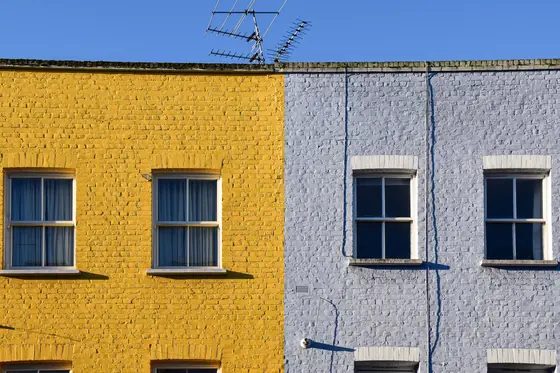
Conservation areas and older brick
The town has two conservation areas, Haverhill Hamlet Road and Haverhill Queen Street, and many Victorian buildings survive. If your house falls inside one, it's worth checking with West Suffolk Council before a noticeable change of exterior colour. We use breathable masonry paints on older brick and render so moisture can escape.
Test patches on a discreet wall let you see a colour in daylight before the whole house is done, which matters more when the house sits in a terrace and neighbours see it too.
Post-war houses and roofline timber
About a third of Haverhill's homes were built between 1965 and 1982, and another quarter between 1983 and 1999, according to Council Tax records. On houses of that age, fascias, soffits, bargeboards and exterior doors usually show wear first. Graham's survey notes failed paint, soft timber and gaps where water could get in, and the repairs go into the written quotation.
Mould and algae on shaded walls are treated with an anti-fungal jet wash, as on a Cambridge house we restored, then left to dry.
Haverhill at a glance
- 21 milesby road from our Landbeach base, about 37 minutesOSRM routing
- 88%are houses rather than flatsCensus 2021
- 25%of homes are detachedCensus 2021
- 6%of properties were built before 1919VOA Council Tax stock
- 2conservation areaslocal council
- 12%were built 1945 to 1964VOA Council Tax stock
How we approach exterior painting
For an end-of-terrace or semi, we'd start with an anti-fungal wash and drying time, then scrape and sand loose paint. Cracks in render are filled, bare timber primed and undercoated, and windows, paths and plants masked. Breathable masonry paint goes on walls, and gutters are painted from the same access as fascias. We book drier months. The full method, products and FAQs are on our exterior painting page.