
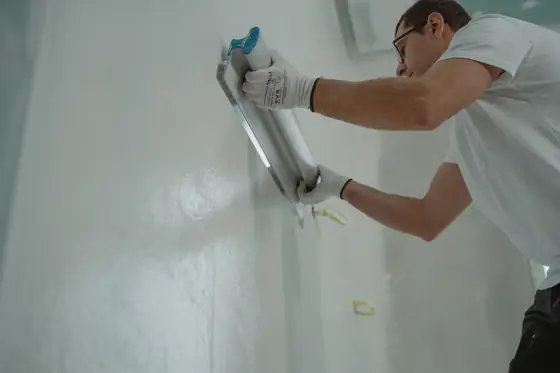
Skimming textured ceilings
Skimming lays a smooth new surface over the texture, and it's quicker and far less messy than pulling a ceiling down. Before Lewis or our master plasterer starts, we take down fittings, sheet the floor and furniture, and prepare the surface so the plaster bonds. A Cambridge customer's ceilings, skimmed by Lewis, are in our Artex case study.
On bigger projects, plastering and decorating can run in parallel, with one room being skimmed while another is stripped.
Cracks, patches and Victorian walls
About 6% of Haverhill's homes predate 1919. In those, stripping old paper can reveal tired lath and plaster that needs re-skimming. Elsewhere, the usual work is ceiling cracks and walls patched over the years. At the survey Graham judges which Haverhill walls really need skimming and which only want filling and lining paper.
Cracks that keep coming back may point to movement or a leak, and we'll say so. Water stains are sealed with Zinsser stain block so they don't bleed through.
Haverhill at a glance
- 21 milesby road from our Landbeach base, about 37 minutesOSRM routing
- 12%were built 1945 to 1964VOA Council Tax stock
- 34%were built 1965 to 1982VOA Council Tax stock
- 6%of properties were built before 1919VOA Council Tax stock
- 11,055householdsCensus 2021
- 2%date from 1919 to 1939VOA Council Tax stock
How we approach plastering
Floors and furniture are covered, fittings removed and the ceiling prepared before skimming. Once the plaster has fully dried, we sand off nibs with a Mirka dust-free sander, apply a thinned mist coat to seal it and show up dips, fill those, then apply two full coats. New coving for a Haverhill room is hung at that stage, ahead of the last coats. The full method, products and FAQs are on our plastering page.