
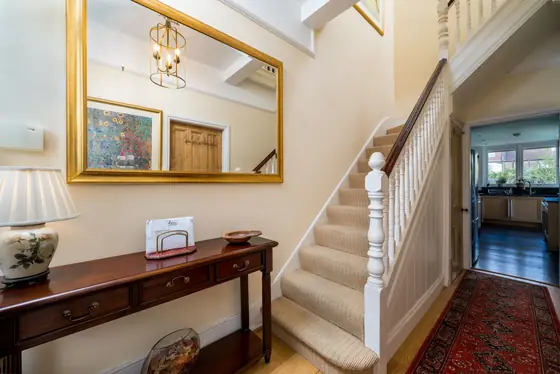
Staircases and internal doors
Stairs stay in use while we work, so we agree a way to keep a route open while coats dry. Treads, handrails and spindles are sanded before staining so the colour takes evenly, then varnished where they get the most wear. Spindles are done one at a time, because rushing them leaves drips that show from the hall below.
Panelled doors are stained in order, panels first then rails and stiles, so wet edges don't overlap and darken.
Period details and painted finishes
Council Tax records date about 6% of the town's homes before 1919, and those Victorian houses often have deep skirtings, picture rails and panelled doors with many old coats. We sand out drips and runs, fill dents and prime bare pine with Zinsser so knots don't bleed.
Most homes here are post-war, and their woodwork often just needs cleaning, keying and repainting. Satin or eggshell is kinder than gloss on older timber. Our main staining and varnishing page has more examples.
Haverhill at a glance
- 21 milesby road from our Landbeach base, about 37 minutesOSRM routing
- 6%of properties were built before 1919VOA Council Tax stock
- 2%date from 1919 to 1939VOA Council Tax stock
- 88%are houses rather than flatsCensus 2021
- 36listed buildingsHistoric England
- 60%of homes are owner-occupiedCensus 2021
How we approach woodwork staining & varnishing
We clean grease from door edges, key old gloss with Mirka dust-free sanders, and fill gaps along skirtings and architraves. For stain, the timber is sanded evenly and a test patch goes on a hidden spot for your approval. Clear varnish protects treads and handrails, and we sand lightly between every coat. The full method, products and FAQs are on our woodwork staining & varnishing page.