Oiled beams and natural timber
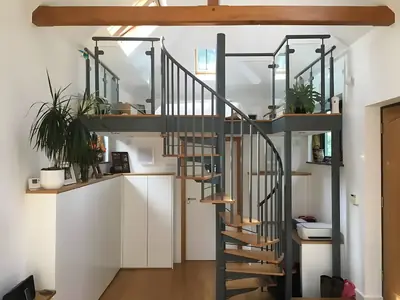
Beams often carry years of dust, wax or smoke, so they are cleaned and sanded before any oil goes on. Osmo soaks into the grain and hardens there, which gives a natural matt look and can be topped up later. The Telephone Exchange project has photos of the finished beams against white walls.
Most of the village's oldest houses were timber-framed, and in some the frame shows inside. Old and newer timber rarely take colour the same way, so we test the finish on both.
Doors, staircases and skirtings
Nearly a third of Fulbourn homes have four or more bedrooms, which usually means a long staircase and a lot of doors. Treads, spindles and handrails are sanded evenly so stain takes without blotching, then given a clear protective coat where they wear.
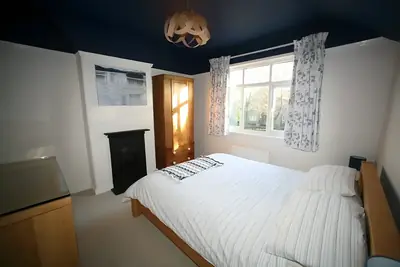
If you prefer painted woodwork, dark trims work well. The trim at the Exchange went in Dulux Night Jewels 2. For listed homes, of which the parish has 56, check before stripping any historic finish.
Fulbourn joinery: mostly post-war, some of it listed
Period joinery is the exception in Fulbourn. The VOA dates 12.9% of the parish's properties to before 1945, so most doors, stairs and skirtings here belong to post-war and modern houses. In those, the likely job is refreshing a worn varnish, changing a stain colour or painting over pine, and the right answer depends on what's already on the timber, which Graham checks door by door at the visit. With 1,414 households, 65.6%, owning their home at the 2021 Census, most of those choices are the owner's own, while tenants will need the landlord's say before anything is stripped or re-stained.
The older joinery sits in a smaller group of houses, including some of the parish's list entries, such as Hall Farmhouse, Old Meldrith and the coach house and stables at Fulbourn Manor House, though an entry's name says nothing about the timber inside. Our own Fulbourn woodwork is at the Old Telephone Exchange: the beams and kitchen worktops were oiled with Osmo, and the case study has 11 photos of the result.
Figures from 2021 Census (ONS); Valuation Office Agency Council Tax stock by build period; Historic England's National Heritage List; Historic England conservation areas. Source: Office for National Statistics licensed under the Open Government Licence v.3.0. Contains public sector information licensed under the Open Government Licence v3.0. © Crown Copyright 2026. Contains Ordnance Survey data © Crown copyright and database right 2026. Released under OGL. © Historic England and Local Planning Authorities 2026.
Fulbourn at a glance
- 6 milesfrom our Landbeach base in a straight line, about 17 minutes by roadOSRM routing
- 9%of properties were built before 1919VOA Council Tax stock
- 4%date from 1919 to 1939VOA Council Tax stock
- 91%are houses rather than flatsCensus 2021
- 56listed buildingsHistoric England
- 66%of homes are owner-occupiedCensus 2021
Sources: Census 2021 for Fulbourn parish (ONS); Council Tax: stock of properties, 2026; Historic England listed buildings; road distance by OSRM.
Listed buildings and conservation areas in Fulbourn
- Highfield HouseGrade II* listed
- Church of St VigorGrade II* listed
- The Maltings Buildings Immediately South of Malsters CottageGrade II listed
- FulbournConservation area
- Fulbourn HospitalConservation area
Sources: Historic England listed buildings; Historic England conservation areas.
Listed buildings: check before changing original woodwork
If your house is listed, ask South Cambridgeshire District Council before stripping, staining or painting historic joinery such as panelled doors, staircases or beams, since its listed buildings page says listed building consent is required for any work that affects the character of the building. For a front door or windows on a house inside the Fulbourn or Fulbourn Hospital conservation area, the council's advice is that you may need planning permission for some works which would otherwise not need permission, so check before a change of colour or finish.
Council page: listed buildings · Listed Buildings SPD (PDF) · Council page: conservation areas
How we approach woodwork staining & varnishing
For Fulbourn joinery we'd start by finding out what's already on the timber, because varnish, stain, paint and oil each need a different approach. Old finishes are sanded back evenly with Mirka dust-free sanders so they don't leave pale patches, bare pine is primed with Zinsser before eggshell or Tikkurila satin, and beams and worktops have Osmo oil worked into the grain. Doors are taken in an order that keeps the rooms you need in use. Our woodwork staining & varnishing page sets out each step, the products we use and the questions people ask most.
Paint applied to woodwork before the 1960s may contain lead, so it should be tested before anyone sands it; if lead is found it is never dry sanded or burnt off, but prepared with wet, low-dust methods and the area cleaned thoroughly afterwards.