
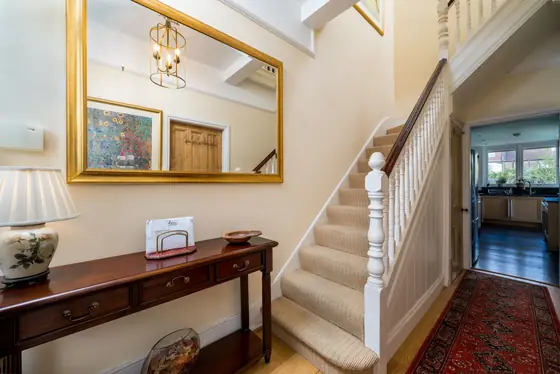
Staircases and doors in Milton's newer homes
If your stairs and doors are softwood that was painted white or given a clear varnish years ago, the finish has probably dulled or yellowed by now. Sanding back evenly lets a new stain take without blotches, and a clear coat over it protects the treads and handrail. We test the stain under a tread or on the back of a door first so you can approve the colour.
In Fordham, Valter and Denes stained a staircase and doors for Mrs M Turner, who wrote about the amazing transformation and how punctual they were. You can read her words and others on our reviews page.
Gloss, satin or eggshell for skirtings
Painted woodwork doesn't have to be white gloss. Satin and eggshell have a lower sheen and show fewer dents in older timber, and painting skirtings in the wall colour can make a room feel calmer. In older Milton properties, including any of the 16 listed buildings, we treat original joinery with extra care and prime bare pine with Zinsser to stop knots bleeding through.
Milton at a glance
- 2 milesby road from our Landbeach base, about 4 minutesOSRM routing
- 3%of properties were built before 1919VOA Council Tax stock
- 3%date from 1919 to 1939VOA Council Tax stock
- 83%are houses rather than flatsCensus 2021
- 16listed buildingsHistoric England
- 68%of homes are owner-occupiedCensus 2021
How we approach woodwork staining & varnishing
We clean greasy areas around handles, sand old gloss to give the new coat grip, and fill gaps where skirtings meet the wall. Stain goes onto evenly sanded timber after a test patch. Paint goes on over Zinsser primer where wood is bare, with a light sand between coats. Mirka dust-free sanders keep the rest of the house clean. The full method, products and FAQs are on our woodwork staining & varnishing page.