
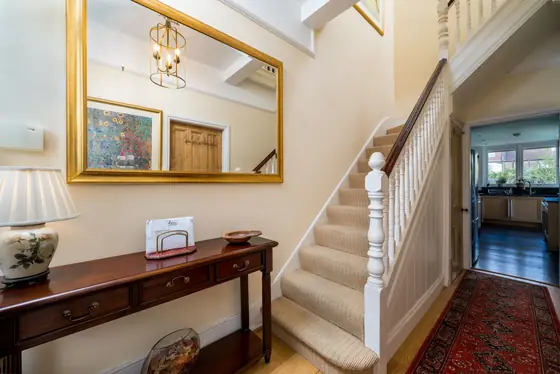
Picture rails, skirtings and doors in older houses
In the Victorian house we decorated in Histon, the picture rails, cupboard doors, skirtings and door frames were all made good, primed, undercoated and finished in white, framing Khaki Mist walls and a Sapphire Salute ceiling. Period woodwork like this usually carries decades of paint runs, so most of the time goes into sanding and filling.
Interwar homes make up about 14% of the local stock and often have panelled doors and deeper skirtings. Later houses usually have flush doors and simpler profiles, which suit satin or eggshell and are quicker to prepare.
Stained stairs and natural timber
A stained staircase needs even sanding of every tread, spindle and handrail first, or the colour goes blotchy. We test the stain somewhere hidden, such as under a tread, before you approve it, and a clear protective coat goes on the parts that take wear. Our staining and varnishing page explains the options.
Historic England lists 38 buildings in the two parishes. If yours is one, check with the council before stripping or replacing original joinery.
Histon & Impington at a glance
- 5 milesby road from our Landbeach base, about 10 minutesOSRM routing
- 10%of properties were built before 1919VOA Council Tax stock
- 14%date from 1919 to 1939VOA Council Tax stock
- 90%are houses rather than flatsCensus 2021
- 38listed buildingsHistoric England
- 68%of homes are owner-occupiedCensus 2021
How we approach woodwork staining & varnishing
Doors are cleaned around the handles, keyed and filled, then finished in gloss, satin or eggshell, with Tikkurila satin a common choice. Any bare pine gets a coat of Zinsser primer to seal the knots. For a stained staircase we sand evenly with Mirka dust-free sanders, test the colour, then seal treads and handrails. The full method, products and FAQs are on our woodwork staining & varnishing page.