
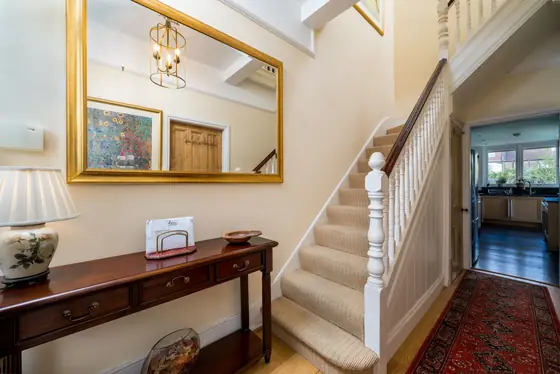
Stairs and doors in family houses
If your doors and banisters are still in a varnish that has gone yellow or orange, we can sand and re-stain the timber, or prime and paint it for a lighter look. Painted woodwork that is chipped at every edge gets filled, sanded and recoated.
Stairs stay in use while we work, so we agree with you how to keep a route up and down. Valter and Denes did exactly this kind of work on a staircase and doors for Mrs M Turner in Fordham, and the staining was what she praised most.
Choosing between stain, varnish and paint
Varnish forms a tough clear layer for handrails and doors that get handled. Oil, such as Osmo, soaks in and is easy to top up. For painted woodwork, satin and eggshell have a lower sheen than gloss and hide small dents. We test stain on a hidden area, such as the back of a door, so you can approve the colour.
Skirtings and doors can match the walls for a calmer room, as with the Skimming Stone eggshell in our Cambridge bedroom redecoration.
Bar Hill at a glance
- 10 milesby road from our Landbeach base, about 14 minutesOSRM routing
- 4%of properties were built before 1919VOA Council Tax stock
- 1%date from 1919 to 1939VOA Council Tax stock
- 96%are houses rather than flatsCensus 2021
- 75%of homes are owner-occupiedCensus 2021
How we approach woodwork staining & varnishing
Natural timber is sanded evenly so old varnish doesn't leave pale patches under new stain. Painted woodwork is cleaned of grease, keyed, filled and primed, with bare pine sealed by Zinsser so knots don't bleed. We sand lightly between coats, keep a stair route open, and use Mirka dust-free sanders throughout. The full method, products and FAQs are on our woodwork staining & varnishing page.