
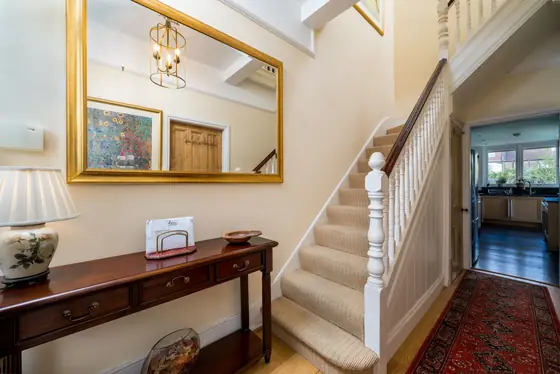
Staircases and doors in Hardwick houses
In a four-bedroom house, and 35% of the village has four or more, the woodwork can take as long as the walls. Handrails and treads get the heaviest use, so after staining we add a clear protective coat on those areas, and keep a route up and down the stairs while each section dries.
Stain only looks even on evenly sanded wood. Any patch of old varnish left behind shows pale, so we sand thoroughly with Mirka dust-free sanders and test the colour somewhere hidden, such as the underside of a tread, before you approve it.
Painted woodwork, from gloss to eggshell
Houses built from 1965 to 1992, about six in ten of Hardwick's homes, often have doors and skirtings carrying several coats of old gloss. Old gloss is too shiny to grip, so it's cleaned and keyed before a new coat. Plenty of owners now switch to satin or eggshell, which shows fewer marks.
For the handful of period buildings, including the listed ones, we prime any bare timber with Zinsser and choose finishes that suit old joinery. Our interior decorating page covers the walls that go alongside.
Hardwick at a glance
- 11 milesby road from our Landbeach base, about 15 minutesOSRM routing
- 2%of properties were built before 1919VOA Council Tax stock
- 5%date from 1919 to 1939VOA Council Tax stock
- 97%are houses rather than flatsCensus 2021
- 7listed buildingsHistoric England
- 77%of homes are owner-occupiedCensus 2021
How we approach woodwork staining & varnishing
We start each Hardwick job by cleaning greasy door edges and dusty skirtings, then sanding everything to a key. Dents and open joints are filled, gaps along the wall line caulked, and bare wood primed. For stained work we test on a hidden area first. Painted work gets an undercoat and two top coats, sanded lightly between each. The full method, products and FAQs are on our woodwork staining & varnishing page.