
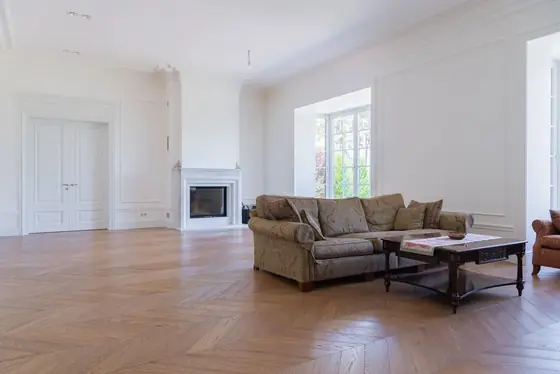
Which Hardwick floors can be sanded
Council Tax records put about 20 homes in the village before 1900 and about 70 between the wars, and those are the likeliest to have solid boards worth restoring. In later houses it depends on what was laid: solid hardwood can be sanded and refinished, while laminate and vinyl cannot, and engineered boards only a limited number of times.
Chris, the wooden floor specialist we work with, checks what you have before anything is quoted. Lifting a corner of carpet is usually enough to tell.
From bare boards to an oiled finish
Chris works across the main floor with a belt sander and finishes the edges with an edging sander. Gaps between boards are filled with the floor's own sawdust mixed with Induro Morrells Mix & Fill, and a Mirka dust-free sander gives the final pass. The finish is Osmo Polyx oil, clear or tinted, as on our Haddenham floor restoration.
If the same rooms are being decorated, we plan floors and walls together so dust never lands on fresh paint and any scuffs on the skirtings are touched in afterwards.
Hardwick at a glance
- 11 milesby road from our Landbeach base, about 15 minutesOSRM routing
- 2%of properties were built before 1919VOA Council Tax stock
- 5%date from 1919 to 1939VOA Council Tax stock
- 12%are terracedCensus 2021
- 7listed buildingsHistoric England
- 1,083householdsCensus 2021
How we approach floor sanding
For a Hardwick home we'd start by confirming the floor is solid timber. Loose boards are fixed and proud nails knocked down, then the floor is sanded through coarse to fine grades. After filling and a dust-free final sand, Osmo oil goes on in thin coats with drying time between them. The room needs to be empty throughout. The full method, products and FAQs are on our floor sanding page.