
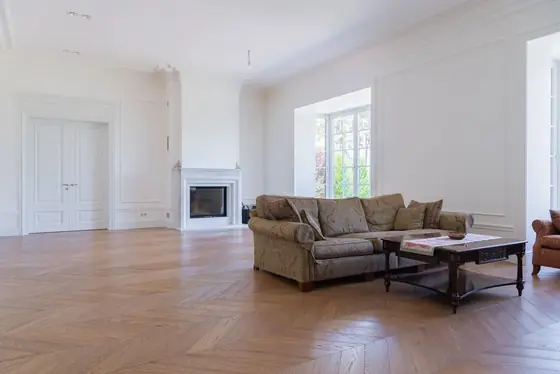
Original boards in interwar Girton
Add the 1920s and pre-1919 properties and roughly a fifth of the village was built with solid timber floors as standard. Boards of that age often carry dark stain around the edges where a carpet or rug once sat, and gaps that have opened over the decades.
Chris, our wooden floor specialist, sands with a belt sander and an edging sander, fills gaps with the floor's own sawdust and Induro Morrells Mix & Fill, then finishes with a Mirka dust-free sander before oiling.
Floor sanding in newer Girton homes
Close to 40% of Girton properties date from 2000 or later, and those homes are more likely to have engineered boards or laminate. Engineered floors may stand one light sand or none, depending on the thickness of the top layer, and laminate can't be sanded at all. Chris identifies the floor type on his first look, before any figure is put on paper.
Terraces make up under 10% of Girton homes, so most floors here are in semis and detached houses, where hall, living and dining room floors can often be done in one booking. See our floor sanding page and the Haddenham floor restoration for the full process.
Girton at a glance
- 8 milesby road from our Landbeach base, about 18 minutesOSRM routing
- 5%of properties were built before 1919VOA Council Tax stock
- 18%date from 1919 to 1939VOA Council Tax stock
- 10%are terracedCensus 2021
- 12listed buildingsHistoric England
- 1,747householdsCensus 2021
How we approach floor sanding
In a Girton 1930s house Chris would first lift a corner of carpet to see the boards, then knock down proud nails and secure loose ones. After sanding from coarse to fine and filling the gaps, the floor is finished in thin coats of Osmo Polyx oil, clear or tinted. If you're redecorating as well, the floors come first and the skirtings are painted after. The full method, products and FAQs are on our floor sanding page.