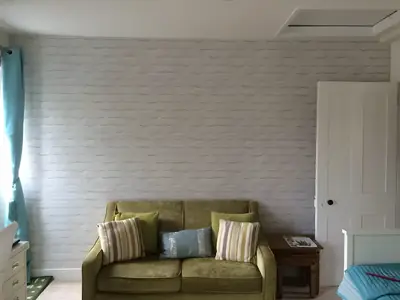
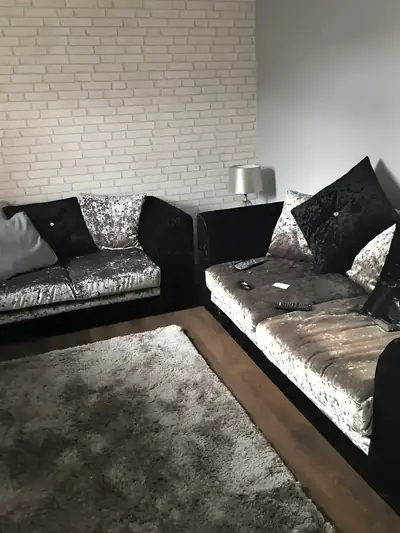
Papering the walls of 1930s and postwar Girton
Council Tax records put around 420 Girton properties in the 1919 to 1939 bracket, with 340 of them from the 1930s alone. Plaster from that period has usually been painted, patched and papered several times over. Strip it back and you find old filler, blown areas and the outlines of previous papers.
We deal with that before any decorative paper goes up. Blown patches are cut out and made good, the wall is sized, and a lining paper is cross-hung so the joins in the finished paper never sit on top of the joins underneath. On a heavy or expensive design, that hidden layer decides whether the paper lies flat or shows every lump.
A wallpaper hanger for Girton owners who plan to stay
With roughly 71% of households owning their home, many Girton customers are choosing paper for the long term: a William Morris pattern in a hall, a grasscloth in a dining room, a mural in a child's bedroom. Simon, our wallpaper specialist, handles the papers that need the most care. You can see how a three-storey stairwell was tackled in our William Morris case study.
The parish has 12 listed buildings, including Girton College and the Church of St Andrew. If you live in a listed house, check with South Cambridgeshire District Council before stripping historic finishes, and we'll work to whatever is agreed.
Which Girton walls need lining before wallpaper goes up
Very little of Girton is Victorian or Edwardian. Council Tax records date about 90 properties to before 1900, only about 20 to the years 1900 to 1918 and roughly 80 to 1919 to 1929, so most of the village's pre-war walls are 1930s ones. The older the wall, the more likely it is to be uneven or hiding several earlier papers, and on walls like that a lining paper under the finish paper is what lets a heavy design lie flat.
In the oldest houses the plaster may be lime, which is softer than modern plaster and can come away with the old paper, so we strip slowly with steam and check the wall before anything new is hung. Girton's 12 list entries, which include Binfield and Jesters at Grade II, are worth bearing in mind too. If your home is one of them, tell Graham before he quotes, and for an expensive heritage paper our designer and William Morris wallpaper page explains how batch numbers and pattern repeats are checked before a roll is cut.
Figures from Valuation Office Agency Council Tax stock by build period; Historic England's National Heritage List. Contains public sector information licensed under the Open Government Licence v3.0. © Crown Copyright 2026. Contains Ordnance Survey data © Crown copyright and database right 2026. Released under OGL.
Girton at a glance
- 4 milesfrom our Landbeach base in a straight line, about 18 minutes by roadOSRM routing
- 5%of properties were built before 1919VOA Council Tax stock
- 18%date from 1919 to 1939VOA Council Tax stock
- 1,747householdsCensus 2021
- 12listed buildingsHistoric England
- 71%of homes are owner-occupiedCensus 2021
Sources: Census 2021 for Girton parish (ONS); Council Tax: stock of properties, 2026; Historic England listed buildings; road distance by OSRM.
Listed buildings in Girton
- Girton CollegeGrade II* listed
- Church of St AndrewGrade II* listed
- 102, High StreetGrade II listed
Sources: Historic England listed buildings.
How we approach wallpapering
Where a Girton wall dates from before the Second World War, we steam the old paper off a section at a time and watch how the plaster behaves, since lime or patched walls can lift with it. Loose areas are cut back and made good, the wall is washed and sized, and lining paper goes on before the finish paper. On walls built in 2025 or 2026, we wait until the plaster has dried out fully, fill any early shrinkage cracks and prime, then hang straight onto the wall. There is more on preparation, products and common questions on our main wallpapering page.