
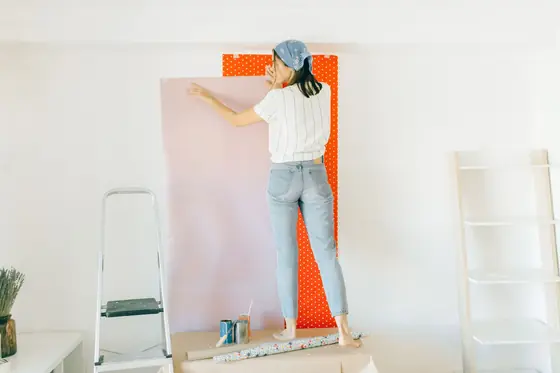
Wallpapering on Northstowe's new plaster
Council Tax records date over 95% of Northstowe's homes to 2000 or later, so lining paper, which older houses so often need, is rarely necessary here. The challenge on fresh walls is different. Bare or lightly painted plaster is very absorbent, and paste soaks in unevenly unless the surface is sized or primed first.
Settlement cracks also need filling and sanding before any paper goes up, or they can show as fine lines through thinner papers.
Feature walls, bedrooms and stairwells
A wall behind the bed, across an alcove or along a dining area is the usual starting point. Simon, our wallpaper specialist, plans where the pattern will fall so the joins sit out of the eye line. Stairwells in three-storey houses take longer drops, and every length is set from a plumb line rather than the one beside it.
If you'd like to see heritage papers hung over several floors, the William Morris staircase project is a good example. Murals and photo papers are covered on our main wallpapering page.
Northstowe at a glance
- 13 milesby road from our Landbeach base, about 18 minutesOSRM routing
- 1%of properties were built before 1919VOA Council Tax stock
- 0%date from 1919 to 1939VOA Council Tax stock
- 1,019householdsCensus 2021
- 2listed buildingsHistoric England
- 72%of homes are owner-occupiedCensus 2021
How we approach wallpapering
We fill and sand any settlement cracks, then size or prime the plaster so the paste grips evenly. Batch numbers are checked and the pattern is dry-laid before cutting. Traditional papers are pasted on the table, non-woven papers on the wall, each following the maker's instructions, and every drop is hung from a plumb line. The full method, products and FAQs are on our wallpapering page.