
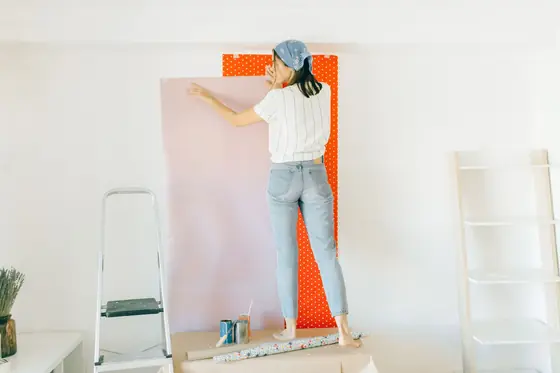
Older walls and why we line them
About 10% of local properties date from before 1919 and another 14% from the interwar years. In houses like these the plaster has often been patched over generations, and a heavy or patterned paper shows every dip. Cross-lining first gives the finish paper an even, absorbent surface and stops the joins opening as it dries.
We saw this first-hand in a Victorian house in Histon, where the original sand and stone plaster needed lining in places. Homes from the 1980s and 1990s are a different story, with walls that are usually smooth enough to paper directly once sized.
Listed buildings and designer papers
Historic England lists 38 buildings across the two parishes, including the Grade II* Olde House and Impington Mill. If your home is one of them, ask South Cambridgeshire District Council before stripping original wall finishes, and mention it to Graham so the quotation allows for gentler preparation.
Many owners here choose a single feature wall in a hall or bedroom; others want a whole stairwell papered. Simon, our wallpaper specialist, handles the pattern-heavy and designer papers, as he did on our William Morris staircase in Cambridge.
Histon & Impington at a glance
- 5 milesby road from our Landbeach base, about 10 minutesOSRM routing
- 10%of properties were built before 1919VOA Council Tax stock
- 14%date from 1919 to 1939VOA Council Tax stock
- 3,747householdsCensus 2021
- 38listed buildingsHistoric England
- 68%of homes are owner-occupiedCensus 2021
How we approach wallpapering
In an interwar semi we'd strip back to the plaster, wash off the old paste and fill any cracks before hanging lining paper horizontally. Once that has dried, the finish paper goes up from a plumb line, with batch numbers checked and the pattern set out so the least visible join lands in a corner. The full method, products and FAQs are on our wallpapering page.