
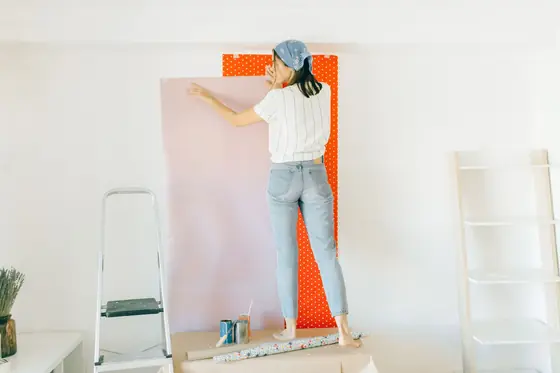
Wallpapering older Waterbeach walls
Council Tax records count about 170 properties in the village built before 1900. Walls of that age have usually been patched and repainted many times, and a heavy or patterned paper shows every ridge. On walls like these we hang lining paper first, so the finish paper has an even surface to dry onto.
Waterbeach also has 21 listed buildings and its own conservation area. If your home is listed, check with South Cambridgeshire District Council before removing historic finishes, and Graham will raise it when he visits.
Feature walls in the newer parts of the village
A third of Waterbeach homes went up after 2000, and the new development on the former barracks and airfield north of the village received its first residents in 2022. New plaster is often smooth enough to paper without lining, but it has to be sealed first or the paste soaks in unevenly.
A single papered wall behind a bed or along a dining area is a popular choice in homes like these. Simon, our wallpaper specialist, plans the repeat so joins fall where the eye won't catch them. For heavier heritage papers, the William Morris staircase project shows how we set out a pattern over three floors, and our main wallpapering page covers murals and photo papers.
Waterbeach at a glance
- 1 milesby road from our Landbeach base, about 2 minutesOSRM routing
- 8%of properties were built before 1919VOA Council Tax stock
- 4%date from 1919 to 1939VOA Council Tax stock
- 2,411householdsCensus 2021
- 21listed buildingsHistoric England
- 64%of homes are owner-occupiedCensus 2021
How we approach wallpapering
Old paper is stripped back to the plaster, the paste washed off and every crack filled. Pre-1919 walls in Waterbeach usually get lining paper, while newer plaster gets a size or primer so the paste grips evenly. Each drop is hung from a plumb line, and with designer papers we check batch numbers and dry-lay the pattern before cutting a single length. The full method, products and FAQs are on our wallpapering page.