
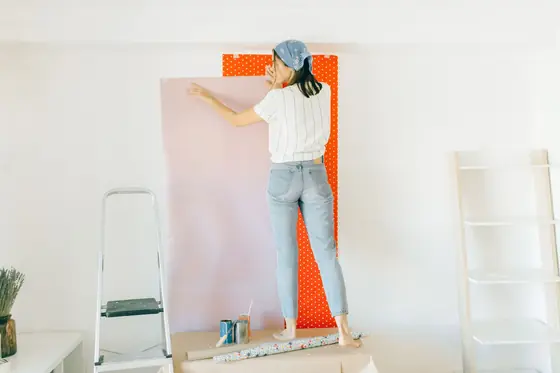
Wallpaper on Fulbourn's older walls
Records of the village describe about 40 houses built before 1800 still standing in the 1980s, most of them timber-framed, some later cased in brick and half still thatched. Walls in houses of that age can lean, bow and change texture from one panel to the next.
On walls like these we usually hang lining paper first. It evens out the surface so the finish paper dries flat, and it makes the pattern easier to keep straight when the wall itself is not. Simon, our wallpaper specialist, plumbs every drop rather than following the corner.
Listed homes and newer houses
Fulbourn has 56 listed buildings, including two at Grade II*. If yours is one of them, it is worth checking with South Cambridgeshire District Council before removing anything historic. We can protect an old paper you want to keep, as we did with a William Morris paper in a Cambridge stairwell.
Only about 9% of local homes predate 1919, though. Plenty of our Fulbourn enquiries will come from 1980s and newer houses, where the walls are flatter and a feature wall behind the bed or across a chimney breast goes up quickly.
Fulbourn at a glance
- 10 milesby road from our Landbeach base, about 17 minutesOSRM routing
- 9%of properties were built before 1919VOA Council Tax stock
- 4%date from 1919 to 1939VOA Council Tax stock
- 2,158householdsCensus 2021
- 56listed buildingsHistoric England
- 66%of homes are owner-occupiedCensus 2021
How we approach wallpapering
We strip old paper, wash off the paste and fill cracks before anything new goes up. On timber-framed or patched walls we line first and leave it to dry. Batch numbers are checked, the repeat is set out from the most visible wall, and every drop is hung to a plumb line. The full method, products and FAQs are on our wallpapering page.