
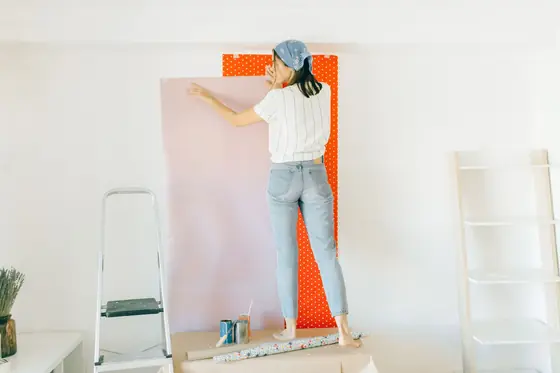
Papering Teversham's newer walls
Only about 1.6% of the village's homes predate 1919, according to Council Tax records, so the soft, uneven plaster that makes us line every wall in older villages is rare here. Most walls take paper well. The catch is that paper hung straight onto unsealed plasterboard can tear the board's face when it's stripped, so we test a corner, soak gently and seal anything that lifts.
Where cracks run along the board joints, lining paper still helps the finish paper dry flat. Graham will tell you at the visit whether a room needs it, and the quotation lists preparation and hanging as separate items.
Feature walls, owners and Teversham's listed houses
A feature wall behind a bed or along a dining wall is how many owners start. Simon, our wallpaper specialist, plans where the pattern falls so the main motif sits centrally and the least visible join ends up in a corner. For larger work, see the William Morris hall and stairs we papered over three floors in Cambridge.
Eight buildings in the parish are listed, among them Teversham Hall and Manor Farmhouse. If you live in one, check with South Cambridgeshire District Council before removing anything original.
Teversham at a glance
- 8 milesby road from our Landbeach base, about 11 minutesOSRM routing
- 2%of properties were built before 1919VOA Council Tax stock
- 6%date from 1919 to 1939VOA Council Tax stock
- 1,225householdsCensus 2021
- 8listed buildingsHistoric England
- 51%of homes are owner-occupiedCensus 2021
How we approach wallpapering
We test how the existing paper comes away, then strip with care, wash off old paste and fill joints and fixing holes. Where the manufacturer recommends it, the wall is sized or primed. Lining paper goes only on cracked walls. Pattern repeats are set out from a plumb line before the first drop is cut, and batch numbers are checked. The full method, products and FAQs are on our wallpapering page.