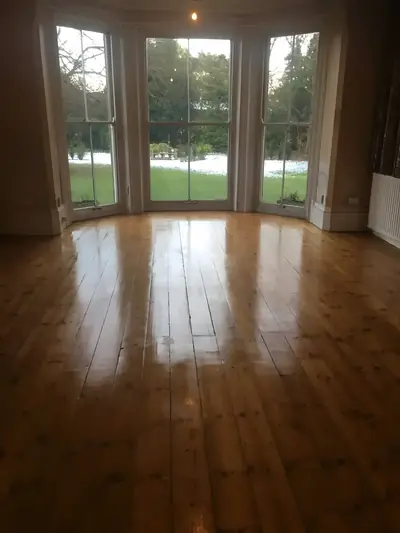
Which floors in the village can be sanded
Council Tax records list about 20 homes in the parish from before 1900 and around 80 from the interwar years, and those are the likeliest to have original softwood boards. In the much larger 1980s stock, the floor under the carpet may be chipboard or concrete, which can't be sanded, though many owners have since laid solid hardwood that can.
Engineered boards have only a thin wear layer and may take one sanding or none. Chris, our wooden floor specialist, checks before anything is quoted and will tell you plainly if sanding isn't the answer.
How Chris brings a floor back
He sands the main area with a belt sander through coarse to fine grades, reaches the edges with an edging sander, fills gaps with the floor's own sawdust mixed with Induro Morrells Mix & Fill, then smooths with a Mirka dust-free sander. Thin coats of Osmo Polyx oil, clear or tinted, finish it. His gold-oiled floor in Haddenham shows every stage.
Chipboard, later hardwood and stair treads: what can be sanded in Teversham
Teversham's likeliest sanding candidates are its older houses: Council Tax records date about 70 homes to the 1930s and 90 to 1955-1964. In the 1980s houses that make up most of the village, the floor under the carpet may be chipboard or concrete, so what matters there is whether a solid hardwood floor has been laid on top since. If you own one of the parish's purpose-built flats, 252 at the 2021 Census, check the lease before lifting carpets, because some leases require floors to be covered to limit noise for the flat below.
Stairs are worth a look too. When a stair carpet comes up, the treads underneath are usually softwood with gripper holes and old paint round the edges, and they can be sanded and varnished or painted, depending on their condition. If any of that old paint went on before the 1960s, it should be tested for lead before it's sanded.
For a let house or flat, an oiled floor has a practical advantage: worn patches in a hallway can be cleaned and re-oiled locally between tenancies, instead of the whole floor being sanded again. Chris will tell you how often the oil he uses should be topped up.
Figures from 2021 Census (ONS); Valuation Office Agency Council Tax stock by build period. Source: Office for National Statistics licensed under the Open Government Licence v.3.0. Contains public sector information licensed under the Open Government Licence v3.0.
Teversham at a glance
- 4 milesfrom our Landbeach base in a straight line, about 11 minutes by roadOSRM routing
- 2%of properties were built before 1919VOA Council Tax stock
- 6%date from 1919 to 1939VOA Council Tax stock
- 19%are terracedCensus 2021
- 8listed buildingsHistoric England
- 1,225householdsCensus 2021
Sources: Census 2021 for Teversham parish (ONS); Council Tax: stock of properties, 2026; Historic England listed buildings; road distance by OSRM.
How we approach floor sanding
Before anything is quoted, Chris lifts a corner of carpet at a doorway in the Teversham property to see what the floor really is. If it's solid timber, the room is emptied and doorways sealed, loose boards are fixed down and nails punched below the surface, and the belt and edging sanders take the old finish off through coarse to fine grades. Where the boards have gaps, Chris works in a mix of their own sawdust and Induro Morrells Mix & Fill; then comes a last pass with a Mirka dust-free sander before the Osmo oil, which is laid on thinly in more than one coat. How we work, step by step, and the questions people usually ask are on our floor sanding page.