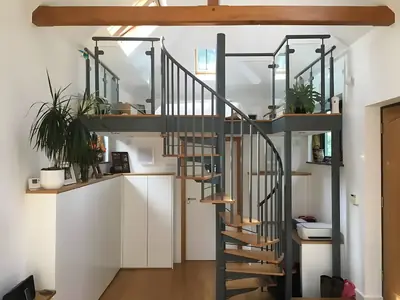
Stairs and doors in Teversham's 1980s houses
Softwood staircases and internal doors from that period often carry an old varnish that has turned orange, or a gloss that has yellowed. We clean and sand them so a new finish grips, then either stain and varnish, or prime and paint in satin or eggshell. We agree a route up and down the stairs with you while each section dries.
In Fordham, Valter and Denes stained a staircase and doors for Mrs M Turner, who thanked us for 'the amazing transformation'. More comments like hers are on our reviews page.
Stain, varnish, oil or paint
Varnish leaves a hard clear layer that suits handrails and doors that get handled. Osmo oil soaks in and can be topped up later, which suits beams and worktops. Paint hides patched or mismatched timber, and satin is the easier sheen to wipe in a family hallway.
Teversham's listed buildings include the Grade II* Church of All Saints and Teversham Hall, and owners of listed homes should ask before stripping original joinery. Bare pine gets a Zinsser primer before eggshell so knots don't bleed through. Windows are covered on our sash window page.
Lead checks, let-proof finishes and the nearest documented woodwork to Teversham
Council Tax records date 15.6% of Teversham's properties to before 1965, and those are the houses where doors, skirtings and staircases may still carry paint from before the 1960s. That paint may contain lead, so it should be tested before anyone sands it; if lead is present, it's never sanded dry or burnt off, and wet, low-dust methods are used instead. In the 1980s houses that make up most of the village, the issue is more often an old varnish that has gone orange or gloss that has yellowed.
In a let home, the woodwork that suffers most is round the front door and along the hall: door edges, frames and the skirtings that furniture is dragged past. A satin finish wipes clean more easily than eggshell, and a labelled tin of the exact colour left with the landlord makes small touch-ups between tenancies straightforward.
The nearest documented woodwork job is in Fulbourn, about 2 miles away in a straight line, at the Old Telephone Exchange, a converted exchange where the trim went in Dulux Night Jewels 2 against white walls and the beams were oiled with Osmo.
Figures from Valuation Office Agency Council Tax stock by build period. Contains public sector information licensed under the Open Government Licence v3.0.
Teversham at a glance
- 4 milesfrom our Landbeach base in a straight line, about 11 minutes by roadOSRM routing
- 2%of properties were built before 1919VOA Council Tax stock
- 6%date from 1919 to 1939VOA Council Tax stock
- 78%are houses rather than flatsCensus 2021
- 8listed buildingsHistoric England
- 51%of homes are owner-occupiedCensus 2021
Sources: Census 2021 for Teversham parish (ONS); Council Tax: stock of properties, 2026; Historic England listed buildings; road distance by OSRM.
Listed buildings and conservation areas in Teversham
- Church of All SaintsGrade II* listed
- Teversham HallGrade II listed
- Manor FarmhouseGrade II listed
- TevershamConservation area
Sources: Historic England listed buildings; Historic England conservation areas.
How we approach woodwork staining & varnishing
In a Teversham house, Graham first agrees which doors and frames are included and flags anything that may need a lead test. Old varnish and gloss are cleaned of grease and keyed with Mirka dust-free sanders, dents are filled, and knots in bare pine are sealed with Zinsser so they don't bleed through a pale colour. Stained finishes are tried on a hidden spot first, painted woodwork is undercoated and finished in satin or eggshell, and the stairs keep a usable route while coats dry. For the full method and the products we use, see our woodwork staining & varnishing page.