
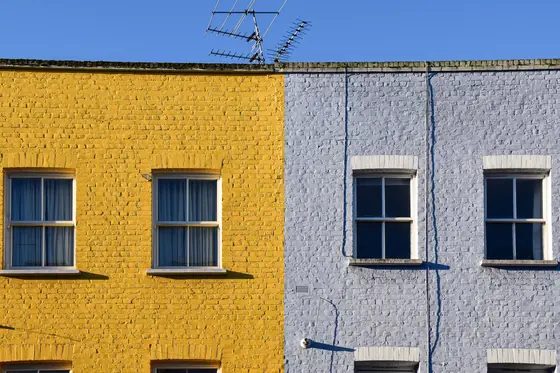
Rooflines and front doors on Teversham houses
Council Tax records put the median build band for the parish at 1983 to 1992. Houses of that age often have facing brick that was never meant to be painted, with timber fascias, soffits, bargeboards and front doors that need recoating every few years. Once that finish fails, water gets into the joints and end grain.
Graham walks round first and notes soft timber, open joints and loose paint. Small areas of rot are cut out and filled; bigger repairs go to our carpenter, and all of it appears in the written quotation before painting starts. Green render or painted masonry is jet washed with an anti-fungal wash and left to dry, the treatment shown in our exterior restoration case study.
Choosing colours inside the conservation area
Part of the village falls within the Teversham conservation area, and the parish has eight listed buildings, including the Grade II* Church of All Saints. If your home is listed, or you're planning a bold change on a prominent elevation, speak to South Cambridgeshire District Council first. We'll paint test patches on a discreet wall so you can see the colour in daylight.
If your windows are white plastic rather than timber, our uPVC spraying page covers those.
Teversham at a glance
- 8 milesby road from our Landbeach base, about 11 minutesOSRM routing
- 78%are houses rather than flatsCensus 2021
- 28%of homes are detachedCensus 2021
- 2%of properties were built before 1919VOA Council Tax stock
- 1conservation arealocal council
- 8%were built 1945 to 1964VOA Council Tax stock
How we approach exterior painting
For a Teversham house we jet wash with anti-fungal solution, scrape and sand loose paint on fascias and doors, cut out minor rot, prime bare timber, then undercoat and top coat. Masonry gets a breathable masonry paint once cracks are filled. We work in dry, mild weather and pause outdoor painting if rain moves in. The full method, products and FAQs are on our exterior painting page.