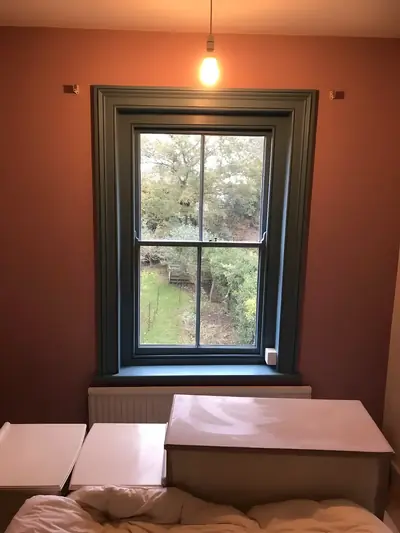
The older Teversham houses that keep their sashes
Historic England lists eight buildings in the parish, with Teversham Hall and Manor Farmhouse among the Grade II entries. Listed homes and the handful of other pre-1900 properties are where original timber sash and case windows survive.
Our part is the decorative work: scraping back loose paint, sanding with Mirka dust-free sanders to keep old paint dust out of the house, filling open joints, priming bare wood and repainting. Rotten timber or broken cords go to our carpenter first, so you still deal with one company.
Keeping sashes sliding after painting
Paint building up in the runners is the usual reason sashes stick. We work each sash up and down during the job, keep paint thin on the sliding faces, and run a neat line onto the glass to seal the putty. Eggshell or satin suits period timber.
If your home has timber casements rather than sashes, those are painted as part of our exterior house painting work.
The few sashes in Teversham: repairing original windows in listed and older houses
Sash windows belong to a small group of Teversham's buildings. Council Tax records date only about 20 homes to before 1900, and the parish has eight list entries, including 6, Church Road, 1, Thurlborns Close and The Rectory. If you live in one of those older houses, the windows are likely to be among the oldest timber in the building, and repair is almost always the first option to consider.
Test the paint before anyone sands it. The older coats on windows from before the 1960s may contain lead, and if they do, dry sanding is ruled out: the paint is taken back wet or with dust-free extraction, the room is sealed off with sheets, and everything is cleaned down at the end. Intact old paint that's left alone is low risk; the danger is in the dust.
If draughts are the reason you're thinking about new windows, ask about draught-proofing first. Our carpenter can look at loose sashes, worn beads and broken cords when he sees the windows, and fixing those before we paint means the new parts are primed and finished with the rest of the frame.
Figures from Valuation Office Agency Council Tax stock by build period; Met Office 1991-2020 climate averages; Historic England's National Heritage List. Contains public sector information licensed under the Open Government Licence v3.0. © Crown Copyright 2026. Contains Ordnance Survey data © Crown copyright and database right 2026. Released under OGL.
Teversham at a glance
- 4 milesfrom our Landbeach base in a straight line, about 11 minutes by roadOSRM routing
- 2%of properties were built before 1919VOA Council Tax stock
- 8listed buildingsHistoric England
- 1conservation areaHistoric England
- 19%are terracedCensus 2021
- 6%date from 1919 to 1939VOA Council Tax stock
Sources: Census 2021 for Teversham parish (ONS); Council Tax: stock of properties, 2026; Historic England listed buildings; Historic England conservation areas; road distance by OSRM.
Listed buildings and conservation areas in Teversham
- Church of All SaintsGrade II* listed
- Teversham HallGrade II listed
- Manor FarmhouseGrade II listed
- TevershamConservation area
Sources: Historic England listed buildings; Historic England conservation areas.
Planning: check before you change a window
Replacing a window on a listed Teversham building, or changing its glazing, frame or opening, needs listed building consent first, because South Cambridgeshire District Council requires consent for any work affecting a listed building's character. Inside the conservation area, check with Greater Cambridge Shared Planning before swapping timber windows for another material; the council's boundary map shows if your house is inside it.
Teversham conservation area boundary map (PDF) · Council guidance on listed buildings · Listed buildings leaflet (PDF)
How we approach sash window restoration
For an old Teversham sash, the room is sheeted and blinds or curtains come down, and any lead test is done before preparation starts. Loose paint is then scraped to a sound edge and the frame sanded with Mirka dust-free sanders, or wet methods are used where the test calls for them. Our carpenter repairs rot, cords and loose beads, failed putty is cut out and renewed, bare timber is primed, and two coats of eggshell or satin finish the frame, inside and out as agreed. How we work, step by step, and the questions people usually ask are on our sash window restoration page.
Best time of year for the work
Outside faces of sashes are best painted in the frost-free part of the year. On the 1991-2020 averages for the Met Office's Cambridge NIAB station, about 5 miles north-west of Teversham, June to September record no air frost, and May and October average under one day each, so we plan outside sash work from late spring into early autumn and keep the inside faces for the rest of the year.