Fulbourn's period windows
Roughly 9% of local homes were built before 1919, according to Council Tax records. Add 56 listed buildings and two conservation areas, and there is a steady handful of houses where the original windows matter to the look of the street.
We prepare, repair-fill and repaint them. Paint is scraped back to a sound edge, cracks and open joints are filled, and bare timber is primed before eggshell or satin goes on. Sills and bottom rails get extra attention because they hold standing water.
When the carpenter comes in
Broken cords, rotten timber and loose sashes are joinery rather than decorating. Our carpenter handles those, and we plan the repair and the paintwork together so the finish is not spoilt by a second visit.
Our main sash window page has more on finishes.
Fewer period homes than England as a whole: sash windows in Fulbourn
Original timber sashes belong mostly to houses built before 1919, and Fulbourn has fewer of those than the district: 8.9% of the parish's properties in the VOA's records, where South Cambridgeshire has 11.2% and England 20.0%. That makes sash work here a specialist job for a fairly small group of owners, and one worth doing properly, because an old sash lasts only as long as its paint keeps water out of the wood.
Some of those houses are listed. The parish has 54 Grade II list entries and two at Grade II*, and Stonebridge Lane has seven entries named by house number, the most of any street in the parish, among them 6, Stonebridge Lane, listed in 1984, and 16, Stonebridge Lane. The list records names and grades, not window types, so Graham looks at each window at the visit and notes what it needs, inside and out.
Figures from Valuation Office Agency Council Tax stock by build period; Met Office 1991-2020 climate averages; Historic England's National Heritage List; Historic England conservation areas. Contains public sector information licensed under the Open Government Licence v3.0. © Crown Copyright 2026. Contains Ordnance Survey data © Crown copyright and database right 2026. Released under OGL. © Historic England and Local Planning Authorities 2026.
Fulbourn at a glance
- 6 milesfrom our Landbeach base in a straight line, about 17 minutes by roadOSRM routing
- 9%of properties were built before 1919VOA Council Tax stock
- 56listed buildingsHistoric England
- 2conservation areasHistoric England
- 18%are terracedCensus 2021
- 4%date from 1919 to 1939VOA Council Tax stock
Sources: Census 2021 for Fulbourn parish (ONS); Council Tax: stock of properties, 2026; Historic England listed buildings; Historic England conservation areas; road distance by OSRM.
Listed buildings and conservation areas in Fulbourn
- Highfield HouseGrade II* listed
- Church of St VigorGrade II* listed
- The Maltings Buildings Immediately South of Malsters CottageGrade II listed
- FulbournConservation area
- Fulbourn HospitalConservation area
Sources: Historic England listed buildings; Historic England conservation areas.
Planning: check before you change a window
If your house is one of Fulbourn's listed buildings, ask South Cambridgeshire District Council before changing the colour of its windows, replacing any part of a sash or altering the glazing. The council's listed buildings page says consent is required for any work that affects the character of the building, and calls unauthorised work to a listed building a criminal offence. Inside the Fulbourn or Fulbourn Hospital conservation area, check the boundary map and ask before changing window colours on the front.
Council page: listed buildings · Fulbourn conservation area map (council, 2021) · Fulbourn Hospital conservation area map (council, 2021) · Listed buildings leaflet (PDF)
How we approach sash window restoration
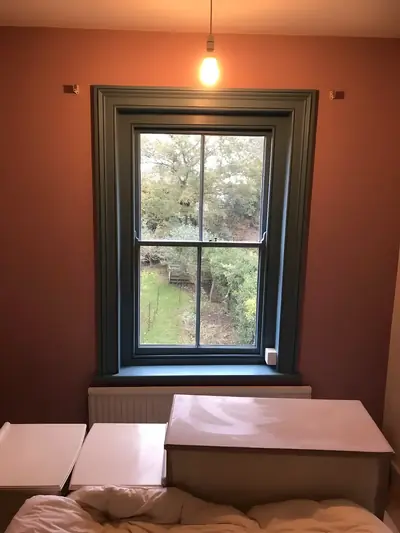
For a Fulbourn sash, the outside faces wait for dry weather, while the inside faces can take a colour, as with the Fired Earth Turkish Blue eggshell on a bedroom window in Cambridge. Old paint is sanded with Mirka dust-free sanders to keep dust out of the room, a fine line of paint is taken onto each pane to seal the putty, and the sashes are worked up and down as we go and eased before we leave each day, so none sets shut.
If the windows were first painted before the 1960s, the lower layers may contain lead: they are tested before work starts, and positive paint is never sanded dry or burnt off.
Best time of year for the work
Outside faces are planned for the six months from May to October, each of which averaged under one day of air frost at the Met Office's Cambridge NIAB station, about 7 miles north-west of Fulbourn, over 1991-2020. October is also that station's wettest month on average, at 59 mm, so late-season sash work goes in the diary as early as the forecast allows.