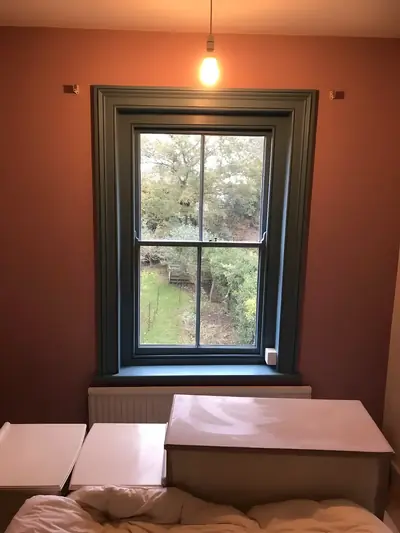
Bottisham's listed windows and the conservation area
All but one of Bottisham's listed buildings are Grade II, including 66 and 78 High Street; the exception is the Grade I Church of Holy Trinity. White or off-white usually suits the street side.
We look after preparation, repair-filling and paint. Rotten timber, broken cords or a replacement sash goes to our carpenter first.
Preparing and painting Bottisham sashes
Using Mirka dust-free sanders, we sand back flaking paint once it's scraped to a firm edge, which keeps dust from possibly lead-bearing old layers out of the room. Open joints and dents are filled and bare timber is primed, with extra care on sills and bottom rails. In a Cambridge job with bare pine frames, we primed with Zinsser before two coats of Elephant's Breath eggshell.
We move each sash during the work so both faces are painted and the runners stay clear, then seal the putty with a neat line onto the glass.
Bottisham's timber sashes: a small but important group
Sash windows are uncommon in Bottisham, and the build dates show why. In the statistical area that holds about 70% of the parish's households, only 2.8% of properties were built before 1919, the period when timber sashes were the usual window.
Those that survive are most likely in the older houses, including the listed ones. The parish has one Grade I entry, the church, no Grade II* and 24 entries at Grade II, among them The Grange and Bottisham Place. On a listed house the aim is to keep the windows you have working and weathertight with careful preparation, filling and paint, and our carpenter deals with rot or broken cords before we decorate.
That makes sash work a small, specialist service here. It suits owners of the parish's older houses, listed or not, who want to keep their timber windows, and it can be combined with repainting the rest of the outside of the house.
Figures from Valuation Office Agency Council Tax stock by build period; Met Office 1991-2020 climate averages; Historic England's National Heritage List; Historic England conservation areas. Contains public sector information licensed under the Open Government Licence v3.0. © Crown Copyright 2026. Contains Ordnance Survey data © Crown copyright and database right 2026. Released under OGL. © Historic England and Local Planning Authorities 2026.
Bottisham at a glance
- 5 milesfrom our Landbeach base in a straight line, about 12 minutes by roadOSRM routing
- 25listed buildingsHistoric England
- 1conservation areaHistoric England
- 15%are terracedCensus 2021
Sources: Census 2021 for Bottisham parish (ONS); Historic England listed buildings; Historic England conservation areas; road distance by OSRM.
Listed buildings and conservation areas in Bottisham
- Church of Holy TrinityGrade I listed
- 66, High StreetGrade II listed
- 78, High StreetGrade II listed
- BottishamConservation area
Sources: Historic England listed buildings; Historic England conservation areas.
Planning: check before you change a window
If your house is one of Bottisham's listed buildings, speak to East Cambridgeshire District Council before changing the colour of its windows or replacing any part of a sash. The council's listed buildings page says exact like-for-like repairs in traditional materials normally won't need consent, and anything that goes further is a question for the council. Inside the conservation area, it's still worth asking before a colour change.
Council page: listed and historic buildings · Bottisham conservation area map (council)
How we approach sash window restoration
For a Bottisham sash we'd start inside, freeing any sash that has been painted shut so both can move, then work outwards: loose paint scraped back to a firm edge, sanding with Mirka dust-free sanders to keep old paint dust out of the room, filling, and Zinsser primer on bare wood, with sills and bottom rails given the most care. Outside faces wait for dry weather. Paint is kept thin on the sliding edges, and a fine line just onto each pane keeps rain off the putty. Our sash window restoration page sets out each step, the products we use and the questions people ask most.
Best time of year for the work
Cambridge NIAB's records for 1991-2020 show air frost in April in 24 of the 30 years, in May and October in 9 years each, and in no year at all from June to September. The station is about 7 miles west of Bottisham, so we plan the outside faces of sashes for that frost-free run and leave the inside faces for whenever suits you.