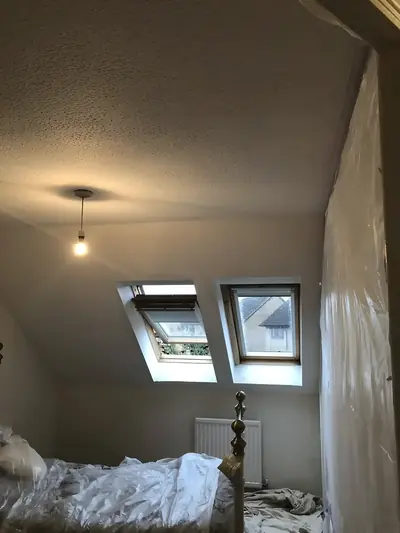
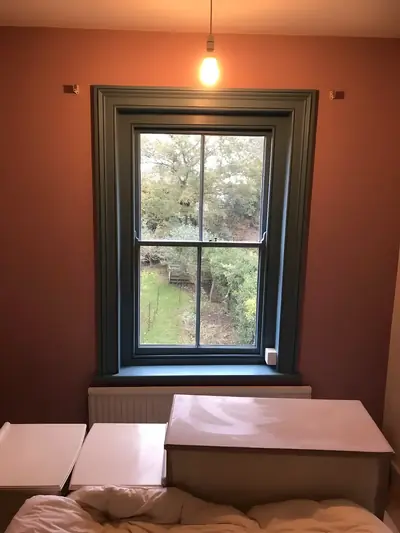
Artex ceilings on the Park Estate
Skimming puts a thin new coat of plaster over the texture. Our job beforehand is to sheet the room, unscrew light fittings and treat the surface so the plaster from Lewis, our plasterer, takes hold. Our ceiling skimming and repair page covers cracked ceilings too.
When it has dried out completely, a Mirka dust-free sander smooths it and a thinned mist coat shows up any dips that need attention.
Older houses, cracks and stains
The older village is a different job. Among Bottisham's 25 listed buildings and in the conservation area there may be walls of lath and plaster or old lime plaster, and repairs there need materials suited to the building. Graham will say honestly whether a job is for our plasterers or a specialist.
Fine cracks just need opening up slightly and filling. Persistent ones are a different matter, as they can mean movement or a leak, and we'll tell you if we suspect either. Water stains are sealed with Zinsser before decorating, and in a Farrow & Ball redecoration in Cambridge we repaired deep ceiling cracks before any paint went on.
Post-war ceilings and newer plasterboard in Bottisham
A lot of Bottisham's housing dates from after the war. In the statistical area that covers about 70% of its households, Council Tax records date 210 properties, 29.6% of those with a known build period, to 1945-64, and another 120 to 1965-82. Homes of that era are where Artex and other textured ceilings turn up most often.
The 1945-64 share there is much higher than East Cambridgeshire's 11.5% or England's 16.1%, so textured ceilings are likely to be a more common find in Bottisham than in East Cambridgeshire as a whole. If preparation uncovers cracks under the texture or the old paint, we'll show you and agree what's needed before going any further.
Newer houses need something different. In a home built since 2000, fine cracks along plasterboard joints are normally filled, sanded and painted rather than skimmed, and Graham will tell you at the visit which treatment each ceiling needs.
Figures from Valuation Office Agency Council Tax stock by build period. Contains public sector information licensed under the Open Government Licence v3.0.
Listed buildings: check before plastering
If your house is one of Bottisham's listed buildings, ask East Cambridgeshire District Council before old plaster is taken off or covered. The council's listed buildings page says repairs and maintenance normally won't need consent when done on an exact like-for-like basis with traditional materials, so patching lime with lime is the straightforward case, while skimming an old wall in modern plaster is one to raise with the council first.
How we approach plastering
For a post-war Bottisham house we'd clear or sheet the room, take down light fittings and smoke alarms, and prepare the textured ceiling so Lewis's skim bonds to it. The plaster is then left until it has dried out completely, sanded with a Mirka dust-free sander and sealed with a thinned mist coat; anything the mist coat shows up is filled before two finish coats. Walls are done after the ceiling, in the same visit. There is more on preparation, products and common questions on our main plastering page.
The Health and Safety Executive says textured coatings such as Artex in homes built or refurbished before 2000 may contain asbestos, so a sample should be tested before anyone sands, scrapes or drills it. If asbestos is found, work that disturbs it is a job for an asbestos specialist: we don't remove asbestos. Our Artex skimming page and guide to plastering over Artex set out the safe order of work.