Smoothing Artex in Milton's post-war houses
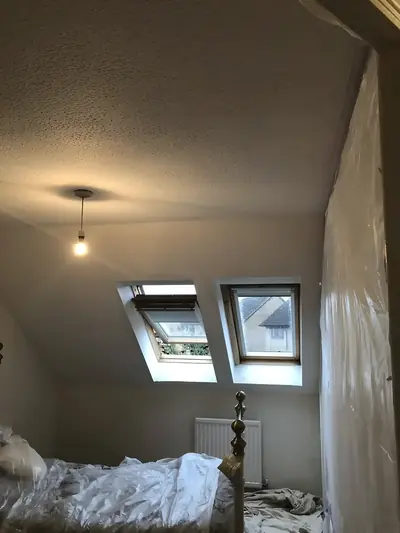
Skimming lays a new smooth coat of plaster over the texture, which is usually quicker and far less messy than taking a ceiling down. Light fittings and smoke alarms come down, floors and furniture are covered, and the surface is prepared so the new plaster bonds. Lewis, our plasterer, or the master plasterer we work with does the skim.
One Cambridge customer who was fed up with Artex had theirs skimmed by Lewis and remarked on how tidy he left the house. The Artex skimming case study shows the result.
Cracks in later plasterboard ceilings
More than half of Milton's homes were built after 1983. Their ceilings are usually plasterboard, and the joints between sheets can crack as a house settles. Hairline cracks are filled and sanded. Wider or recurring ones may need taping and skimming, and if a crack suggests a leak above, Graham will say so rather than paint over it.
Water-stained patches are sealed with a Zinsser stain block before any emulsion goes on.
Textured ceilings from 1945 to 1982, and Milton's oldest plaster
About 500 Milton properties, 24.2% of those with a known build date, were built between 1945 and 1982, the period most associated with Artex and similar textured ceilings. Here the peak came early, with 270 properties from 1955 to 1964, while the later part of the era is thin: 9.7% of Milton's homes date from 1965 to 1982, against 21.8% across South Cambridgeshire.
Asbestos is the first check. Textured coatings in buildings built or refurbished before 2000 may contain it, the Health and Safety Executive says, so in a Milton home from the 1950s or 1960s a sample is tested before anyone sands, scrapes or drills the ceiling. A skim then covers the texture instead of breaking it up, and Lewis or the master plasterer we work with does that part before our decorators take over, all under one plastering and decorating quotation.
Milton's oldest walls need a different approach. The 60 properties built before 1900 are the likeliest to have lime plaster, which is softer than modern plaster and can come away when old paper is stripped. Not every such wall needs a skim: a Victorian house in Histon kept its original sand and stone plaster, prepared carefully and lined where needed before painting.
Figures from Valuation Office Agency Council Tax stock by build period; Historic England's National Heritage List. Contains public sector information licensed under the Open Government Licence v3.0. © Crown Copyright 2026. Contains Ordnance Survey data © Crown copyright and database right 2026. Released under OGL.
Milton at a glance
- 2 milesfrom our Landbeach base in a straight line, about 4 minutes by roadOSRM routing
- 14%were built 1945 to 1964VOA Council Tax stock
- 10%were built 1965 to 1982VOA Council Tax stock
- 3%of properties were built before 1919VOA Council Tax stock
- 1,926householdsCensus 2021
- 3%date from 1919 to 1939VOA Council Tax stock
Sources: Census 2021 for Milton parish (ONS); Council Tax: stock of properties, 2026; road distance by OSRM.
Listed buildings: check before plastering
If your Milton home is one of Historic England's 16 list entries, such as 1, Church Lane or Essex House, ask South Cambridgeshire District Council before any original plaster is removed, patched in a new material or covered with a skim. In the council's words, listed building consent “is required for any work that affects the character of the building including alterations, extensions and demolition”, and carrying out unauthorised work to a listed building is a criminal offence.
Listed buildings and consent · Listed Buildings SPD (PDF) · Historic England list entry: 1, Church Lane
How we approach plastering
In a 1980s or 1990s Milton house, Graham first decides whether a ceiling needs a full skim or only its cracked board joints filled and taped. Textured ceilings in older homes are tested before anything is disturbed. Our plasterer then works with the room sheeted, the plaster dries out fully, and our decorators sand off nibs with a Mirka dust-free sander, mist coat it and fill anything the mist coat shows before two finishing coats go on.