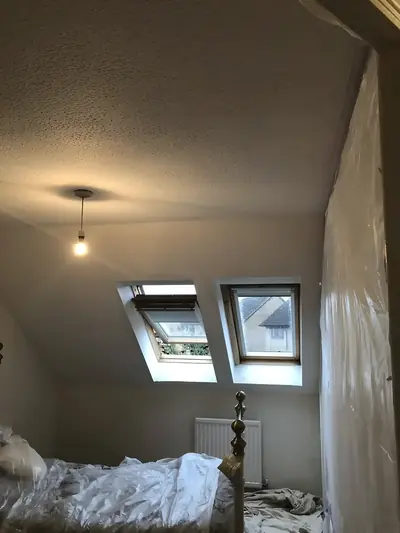
Skimming over Artex in Landbeach
Rather than pulling a textured ceiling down, Lewis or our master plasterer normally skims straight over it with a fresh, smooth coat. Light fittings come down, the room is sheeted, and the surface is sealed so the plaster bonds. It also covers the patched areas left where old light fittings were moved.
Our Artex removal and skimming page explains the process. One Cambridge customer said afterwards how clean and tidy Lewis had left the house.
Lath and plaster in the area's oldest homes
Roughly 90 properties in the area predate 1900. Their walls and ceilings are often lath and plaster, which cracks, sags or comes away in patches as it ages. Small cracks can be cut out and filled; larger areas may need skimming, as we did over old lath plaster in a Cambridge bedroom.
Post-war textured ceilings and older walls in the Landbeach area
Artex and similar textured finishes were widely used on ceilings in homes built from 1945 to 1982. Build dates from Council Tax records cover more than the parish here: in the wider statistical area that takes in all of Landbeach, about 71% of the households are Landbeach ones. Of the properties there with a known build date, 23.7% are from 1965-82 and 13.6% from 1945-64. The 1965-82 share is above South Cambridgeshire's 21.8% and well above England's 18.2%, so a textured ceiling is a likely find in local houses of that age. The usual answer is for Lewis or our master plasterer to skim straight over it, which avoids the mess of bringing the old ceiling down.
Older houses need a different look. The same wider area has 60 properties from 1919-39 and more from before 1919, and in homes that age the walls and ceilings may be lath and plaster, with patched repairs and loose areas that old paper has been holding together. Graham decides at the visit which walls only need filling and lining and which need our plasterers. If the house is listed, check with South Cambridgeshire District Council before original plaster comes off.
Figures from Valuation Office Agency Council Tax stock by build period; Historic England's National Heritage List. Contains public sector information licensed under the Open Government Licence v3.0. © Crown Copyright 2026. Contains Ordnance Survey data © Crown copyright and database right 2026. Released under OGL.
Landbeach at a glance
- Under a milefrom our Landbeach base in a straight line, about 1 minute by roadOSRM routing
- 14%were built 1945 to 1964 (Landbeach and the surrounding area)VOA Council Tax stock
- 24%were built 1965 to 1982 (Landbeach and the surrounding area)VOA Council Tax stock
- 19%of properties were built before 1919 (Landbeach and the surrounding area)VOA Council Tax stock
- 375householdsCensus 2021
- 10%date from 1919 to 1939 (Landbeach and the surrounding area)VOA Council Tax stock
Sources: Census 2021 for Landbeach parish (ONS); Council Tax: stock of properties, 2026, for the statistical areas covering Landbeach and the surrounding area; road distance by OSRM.
Listed buildings: check before plastering
If your house is one of Landbeach's 26 list entries, ask South Cambridgeshire District Council before original plaster is removed, replaced or skimmed over. The council's listed buildings page says consent “is required for any work that affects the character of the building including alterations, extensions and demolition”, and its guidance documents are linked below.
Council page: listed buildings · Listed Buildings SPD (council) · Listed buildings leaflet (council)
How we approach plastering
At the visit Graham sorts each ceiling and wall in a Landbeach house into one of three jobs: fill and paint, line and paint, or skim. In a 1965-82 house the textured ceilings usually fall into the third group, and Lewis or our master plasterer skims them once the room is sheeted and the fittings are down. After the plaster has dried right through, it's sanded with a Mirka dust-free sander and given a thinned mist coat to show any hollows, which are filled before two finish coats. There is more on preparation, products and common questions on our main plastering page.
If your ceiling has Artex and the house was built or refurbished before 2000, the Health and Safety Executive says the coating may contain asbestos: have a sample tested before anyone sands, scrapes or drills it. A positive result makes any work that disturbs it a specialist asbestos job, which we don't do. Our pages on skimming Artex and plastering over Artex explain the order of work.