
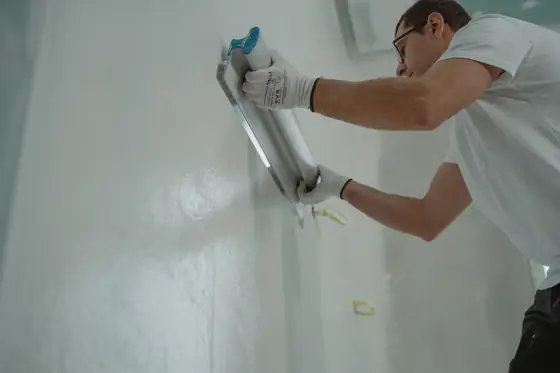
Post-war and 1970s houses with textured ceilings
The 1955 to 1964 band alone accounts for about 450 local properties, and the late 1960s and 1970s add many more. Where an old textured coating has made a room feel dated, Lewis, our plasterer, or the master plasterer we work with can skim it smooth. That's usually quicker and less disruptive than pulling the ceiling down.
Once the new plaster has dried, our decorators sand it with Mirka dust-free sanders and apply a mist coat to show up any imperfections before the finish. A similar job is in our Artex skimming case study.
Older walls in the Victorian houses
About one property in ten predates 1919. In some of those, lath and plaster or original lime finishes come away when old paper is stripped. In others, such as the Victorian house we decorated in Histon with sand and stone plaster, careful filling and lining paper was enough. Graham's survey is where that decision gets made, so you only pay for the plastering a wall needs.
Cracks that keep returning can point to movement or a leak above. If we suspect that, we'll say so before filling over it.
Histon & Impington at a glance
- 5 milesby road from our Landbeach base, about 10 minutesOSRM routing
- 14%were built 1945 to 1964VOA Council Tax stock
- 25%were built 1965 to 1982VOA Council Tax stock
- 10%of properties were built before 1919VOA Council Tax stock
- 3,747householdsCensus 2021
- 14%date from 1919 to 1939VOA Council Tax stock
How we approach plastering
In a 1970s room we'd clear or sheet everything, take down light fittings and prepare the Artex so the skim bonds. After drying, the plaster is lightly sanded, mist coated and checked under a strong side light before two full coats. Water-stained patches are sealed with Zinsser first. Plastering and painting sit on one written quotation. The full method, products and FAQs are on our plastering page.