
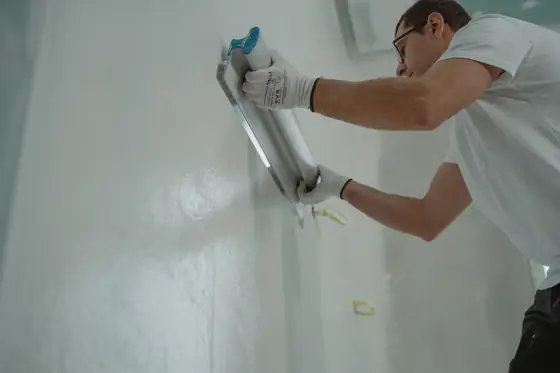
Artex in a planned village
Because the village was built over a short span after its plan was approved in 1964, many houses were finished in similar ways, and textured ceilings were common at the time. Our plasterer Lewis and the master plasterer we work with skim over the texture to give a flat surface. It's quicker and much less disruptive than taking a ceiling down.
Before Lewis starts, we take down light fittings, sheet the floor and furniture, and prepare the surface so the new plaster bonds. You can see how a similar job turned out in our Artex skimming case study.
Old lath and plaster is rare here
Only about 4% of the village predates 1919, so the crumbling lath and plaster walls found in Victorian houses are unusual. More often we're making good after wallpaper comes off, filling cracks along ceiling joints, or skimming a wall that has been patched over the years.
Cracks that return can point to movement or a leak above, and we'll tell you if we think that's the case rather than painting over it.
Bar Hill at a glance
- 10 milesby road from our Landbeach base, about 14 minutesOSRM routing
- 5%were built 1945 to 1964VOA Council Tax stock
- 47%were built 1965 to 1982VOA Council Tax stock
- 4%of properties were built before 1919VOA Council Tax stock
- 1,739householdsCensus 2021
- 1%date from 1919 to 1939VOA Council Tax stock
How we approach plastering
Once a ceiling is skimmed, we leave it to dry fully, sand off nibs with a Mirka dust-free sander and apply a mist coat of thinned emulsion. That shows up any dips to fill before two full coats. Coving can be hung at this stage. Plastering and painting sit in one written quotation. The full method, products and FAQs are on our plastering page.