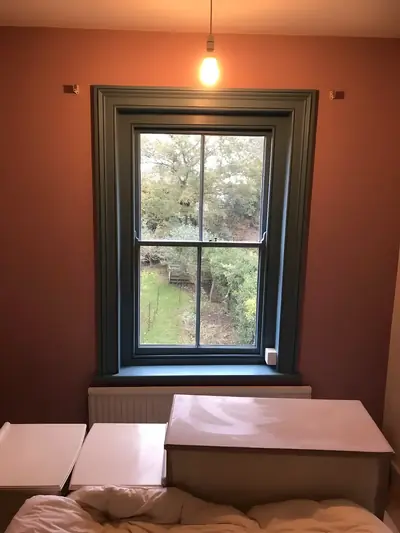
A small number of older homes
Around 70 properties predate 1900 and another 30 date from 1900 to 1918, out of roughly 2,310 in the statistical area around the village. There are no listed buildings and no conservation area within the boundary, so there are no heritage rules on window colour to work around.
Timber windows on later houses need much the same care. Sound paint keeps water out of the joints, and once it cracks, the bottom rails and sills go first.
Painting, filling and when the carpenter comes in
Our side of the job is decorative. We scrape back to a sound edge and sand with Mirka dust-free sanders, which matters because older paint layers can contain lead. Open joints are filled and bare timber primed before eggshell or satin top coats, and sashes are worked up and down so they don't stick.
Broken cords, rotten timber or a sash that needs replacing go to our carpenter, planned alongside the painting. The main sash window page explains the full process.
Sash and case windows around Bar Hill: a short list of houses
Valuation Office records for the wider statistical area around Bar Hill count about 100 properties built before 1919 and 30 from 1919 to 1939, out of roughly 2,310. Timber sash and case windows belong mostly to the oldest of those homes, so you'll find them on a small number of houses rather than along whole streets.
If yours is one of them, our side of the work is the preparation and painting: scraping back to a sound edge, filling open joints, priming bare wood and keeping each sash sliding. New cords, rotten rails and draught-proofing go to our carpenter, booked into the same job, and our guide to sash window upkeep sets out which jobs need a joiner rather than a decorator.
Because there are so few of these windows locally, it helps to know what Graham looks for at the visit: sashes painted shut, cracked or loose putty, soft timber at the sill, and cords that no longer hold. He notes each window separately, so the written quotation shows the work one window at a time.
Figures from Valuation Office Agency Council Tax stock by build period; Met Office 1991-2020 climate averages; Historic England's National Heritage List; Historic England conservation areas. Contains public sector information licensed under the Open Government Licence v3.0. © Crown Copyright 2026. Contains Ordnance Survey data © Crown copyright and database right 2026. Released under OGL. © Historic England and Local Planning Authorities 2026.
Bar Hill at a glance
- 7 milesfrom our Landbeach base in a straight line, about 14 minutes by roadOSRM routing
- 4%of properties were built before 1919 (Bar Hill and the surrounding area)VOA Council Tax stock
- 28%are terracedCensus 2021
- 1%date from 1919 to 1939 (Bar Hill and the surrounding area)VOA Council Tax stock
Sources: Census 2021 for Bar Hill parish (ONS); Council Tax: stock of properties, 2026, for the statistical areas covering Bar Hill and the surrounding area; road distance by OSRM.
Planning: check before you change a window
Bar Hill isn't named on the council's Article 4 register (checked October 2026), and Historic England's data shows no listed buildings or conservation area inside its boundary. The register doesn't say it's complete, so if a window is to be replaced rather than repainted, check with Greater Cambridge Shared Planning first.
Check local planning restrictions with Greater Cambridge Shared Planning
How we approach sash window restoration
On an older Bar Hill house we'd do the inside faces first if the weather isn't settled, scraping to a sound edge, filling and priming bare timber, then working each sash up and down as the coats go on so nothing sets fast. The outside faces follow in a dry spell, with a fine paint line onto the glass to seal the putty. Any carpentry is finished before our first coat.
Best time of year for the work
At the Met Office's Cambridge NIAB station, about 4 miles east of Bar Hill, October is the wettest month on 1991-2020 averages at 58.7 mm, and November brings 3.7 days of air frost and 10.4 days of rain. We'd aim to have the outside faces of sashes painted by early autumn and keep the winter for inside work.