Keeping water out of old window timber
Original sashes last for generations, but only while paint keeps rain out of the joints and bottom rails. Once paint cracks, water gets in and rot speeds up. Our work is the decorative side: scraping back, filling open joints, priming bare wood and building up proper coats. Where timber has rotted or a cord has snapped, our carpenter repairs it before we paint.
Some of the oldest coats on Swavesey windows may contain lead, which is one reason all our sanding uses extracting Mirka machines.
Sash window restoration in Swavesey's conservation area
For listed homes and those in the conservation area, keeping existing windows in good order is often the simpler route. Most people keep to white or off-white outside, with more freedom inside the room.
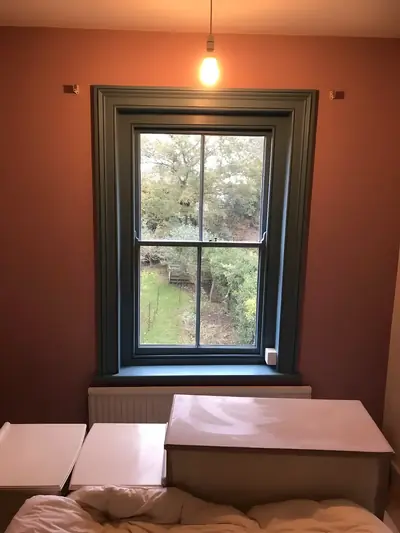
Our sash window restoration page covers finishes, and the Farrow & Ball redecoration shows bare pine frames primed with Zinsser and finished in Elephant's Breath eggshell.
Listed cottages, lead tests and seized pulleys: Swavesey's old windows
Original timber windows are most likely in Swavesey's older and listed houses, such as The Old House, Drayton Cottage, Mill Farmhouse and the two Rose Cottages. On a listed house, repairing and repainting the existing windows is the starting point, since replacing them needs listed building consent, and keeping them in good paint is what stops rot taking hold.
Paint on windows that old should be tested for lead before it's disturbed. Coats from before the 1960s may contain it, and if they do, the frames are rubbed down wet or with dust-free extraction instead of sanded dry, with the room sheeted and cleaned down properly afterwards. Graham will tell you which windows need a test when he looks at them.
Small parts matter on a sash. Pulley wheels painted over in the past can seize, and sash fasteners and lifts buried under paint stop working properly, so they're cleaned back or taken off before painting and refitted afterwards, and the weights and cords hidden in the box are checked at the same time. Our carpenter deals with cords and sticking sashes, and the exterior window painting page covers the outside faces.
Figures from Met Office 1991-2020 climate averages; Historic England's National Heritage List. Contains public sector information licensed under the Open Government Licence v3.0. © Crown Copyright 2026. Contains Ordnance Survey data © Crown copyright and database right 2026. Released under OGL.
Swavesey at a glance
- 8 milesfrom our Landbeach base in a straight line, about 20 minutes by roadOSRM routing
- 14%of properties were built before 1919VOA Council Tax stock
- 28listed buildingsHistoric England
- 1conservation areaHistoric England
- 13%are terracedCensus 2021
- 5%date from 1919 to 1939VOA Council Tax stock
Sources: Census 2021 for Swavesey parish (ONS); Council Tax: stock of properties, 2026; Historic England listed buildings; Historic England conservation areas; road distance by OSRM.
Listed buildings and conservation areas in Swavesey
- The Old Manor HouseGrade I listed
- Ryder's FarmhouseGrade II* listed
- Parish Church of St AndrewGrade I listed
- SwaveseyConservation area
Sources: Historic England listed buildings; Historic England conservation areas.
Planning: check before you change a window
On a listed Swavesey building, changing a window, whether it's the glazing, the timber or the way it opens, needs listed building consent first, because South Cambridgeshire District Council requires consent for any work affecting a listed building's character. Inside the conservation area, ask Greater Cambridge Shared Planning before replacing timber windows with another material.
Swavesey conservation area boundary map (PDF) · Council guidance on listed buildings · Listed buildings leaflet (PDF)
How we approach sash window restoration
For a Swavesey sash, each window is noted at the visit with its condition, and any lead test is arranged before preparation starts. The room is sheeted, fasteners and lifts are removed, and loose paint is scraped back and the frame sanded with Mirka dust-free sanders or taken back wet. Our carpenter repairs rot and renews cords, failed putty is replaced, bare wood is primed, and two coats of eggshell or satin finish the frame before the fittings go back.
Best time of year for the work
Drying slows as the days shorten. At the Met Office's Cambridge NIAB station, about 6 miles south-east of Swavesey, July averages about 190 hours of sunshine on the 1991-2020 figures but September only about 144 hours, so outside sash faces are best painted in early to mid summer, leaving autumn for the inside faces.