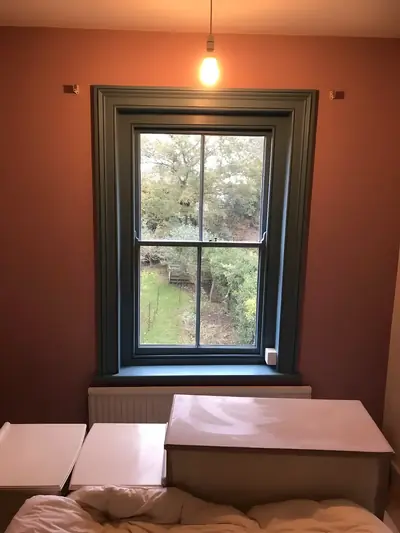
Painting period windows properly
Paint on a sash window has one job: keep water out of the timber. Once it cracks at the joints or along the bottom rail, rot follows. We scrape loose paint back to a sound edge, sand smooth, fill open joints and prime every patch of bare wood before the undercoat and top coats.
Old windows often carry layers of paint that may contain lead. Our Mirka dust-free sanders extract at the source, keeping dust out of the room. Our carpenter takes on broken cords, rotten timber and new sashes, and we decorate once the joinery is done.
Repaint or replace?
If you're weighing up a repaint against new windows, our sash restoration page explains what paint can and can't fix.
Listed town-centre windows, lead tests and thin old glass in St Ives
St Ives' older windows are mostly in the listed streets of the centre and the older houses round it, from Red House to 3-5, Cromwell Terrace and the numbered houses on Broadway and Bridge Street. On a listed building, repairing and repainting the existing sashes is the starting point, because replacing them needs listed building consent.
Before an old sash is sanded, its paint is tested for lead. Coats from before the 1960s may contain it, and if they do, the frames are rubbed down wet or prepared with dust-free extraction, the room is sheeted off and cleaned thoroughly when the work is done. Graham notes at the visit which windows need testing.
Old glass needs a light hand. Older panes can be thinner than modern glass, so scraping and cutting in close to the glass is done by hand with care, and cracked putty is cut out gently. Any pane that's already cracked is pointed out before work starts, so it can be replaced by a glazier if you'd like. Putty that has shrunk away from the glass is renewed, so rain can't get in behind it.
Figures from Met Office 1991-2020 climate averages; Historic England's National Heritage List. Contains public sector information licensed under the Open Government Licence v3.0. © Crown Copyright 2026. Contains Ordnance Survey data © Crown copyright and database right 2026. Released under OGL.
St Ives at a glance
- 11 milesfrom our Landbeach base in a straight line, about 24 minutes by roadOSRM routing
- 7%of properties were built before 1919VOA Council Tax stock
- 152listed buildingsHistoric England
- 1conservation areaHistoric England
- 24%are terracedCensus 2021
- 3%date from 1919 to 1939VOA Council Tax stock
Sources: Census 2021 for St Ives parish (ONS); Council Tax: stock of properties, 2026; Historic England listed buildings; Historic England conservation areas; road distance by OSRM.
Listed buildings and conservation areas in St Ives
- Manor HouseGrade II* listed
- New BridgesGrade II* listed
- The BridgeGrade I listed
- St IvesConservation area
Sources: Historic England listed buildings; Historic England conservation areas.
Planning: check before you change a window
On a listed St Ives building, replacing a sash or changing its glazing or frame needs listed building consent first, and Huntingdonshire District Council says listing brings the need for consent for certain works. For houses inside the St Ives conservation area, ask the council before swapping timber windows for another material or changing their colour.
St Ives Conservation Area Character Assessment (PDF) · Listed building consent, Huntingdonshire District Council
How we approach sash window restoration
For a St Ives sash, each window is noted separately with its condition, and any lead test is arranged before the preparation. The room is sheeted, loose paint is scraped back by hand near the glass and the frame sanded with Mirka dust-free sanders, or taken back wet where the test calls for it. Rot and broken cords are left to our carpenter, putty that has failed is renewed, and the bare wood is primed before eggshell or satin goes on in two coats.
Best time of year for the work
At the Met Office's Monks Wood station, about 9 miles north-west of St Ives, May and July average the fewest days with rain on the 1991-2020 figures, about 8.1 days and 8.2 days, so those are the months we aim the outside faces of sashes at, leaving the inside faces for any time of year.