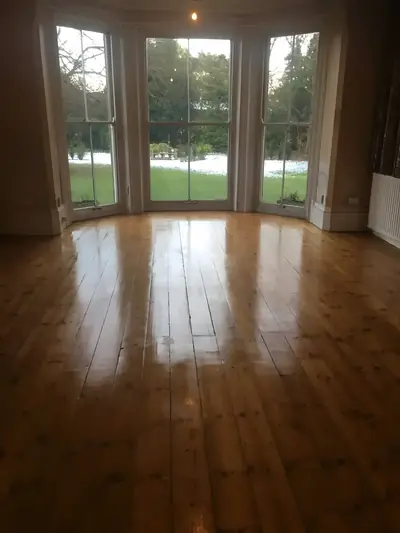
Who floor sanding suits in St Ives
Council Tax records list about 440 St Ives properties from before 1900 and 80 from 1900 to 1918. Older terraces among those are the likeliest to have pine boards under carpet, and lifting a corner is the quickest way to find out. Later houses may have solid oak or another hardwood fitted by a previous owner, which sands well.
Engineered boards are trickier, because the wear layer is thin, and laminate can't be sanded at all. Chris checks your floor before anything is quoted.
Finishing in Osmo oil
Chris finishes floors in Osmo Polyx hardwax oil, clear or tinted. In Haddenham near Ely he used the Gold tint, which has flecks of 24-carat gold; the Haddenham floor case study shows the stages. A worn patch of oiled floor can be cleaned and re-oiled without sanding the whole room.
Pipes, cupped boards and wet rooms: sanding floors in St Ives
Round radiator pipes, hearths and tight corners, the big machines can't reach, so those parts are finished by hand or with a detail sander. On older St Ives floors, from the 440 or so homes built before 1900 to the 180 from the 1930s on Council Tax records, there are usually a few of those spots, and they're allowed for in the quotation. If a plumber can take a radiator off beforehand, the boards behind it can be sanded with the rest of the room.
Old floors are rarely flat. Boards that have cupped or bowed with age can be sanded flatter, but only so far before too much wood comes off, and badly cupped boards may need replacing instead, which our carpenter can do before the sanding starts. Chris checks how much the boards have moved before quoting, so you know what kind of finish to expect.
Water is the enemy of any timber floor, and kitchens and the rooms by a bathroom are where it gets onto the boards. In a kitchen or near a bathroom door, spills and drips should be wiped up rather than left to soak in, because standing water can mark even a well-oiled floor, and a mat by the sink or the bath helps.
Figures from Valuation Office Agency Council Tax stock by build period. Contains public sector information licensed under the Open Government Licence v3.0.
St Ives at a glance
- 11 milesfrom our Landbeach base in a straight line, about 24 minutes by roadOSRM routing
- 7%of properties were built before 1919VOA Council Tax stock
- 3%date from 1919 to 1939VOA Council Tax stock
- 24%are terracedCensus 2021
- 152listed buildingsHistoric England
- 7,522householdsCensus 2021
Sources: Census 2021 for St Ives parish (ONS); Council Tax: stock of properties, 2026; Historic England listed buildings; road distance by OSRM.
How we approach floor sanding
Before quoting a St Ives floor, Chris checks the timber, how far the boards have cupped and where pipes and hearths will need hand work. The room is emptied and doorways sealed, loose boards are fixed and nails set below the surface, and the belt and edging sanders work through coarse to fine grades, with detail sanding round the pipes. Gaps are filled with the floor's own sawdust and Induro Morrells Mix & Fill, a Mirka dust-free sander finishes it, and thin Osmo coats follow. The full method, products and FAQs are on our floor sanding page.
If the floor has painted margins from before the 1960s, that paint may contain lead and should be tested first; where it is positive it is never sanded dry, but taken off with wet, low-dust methods.