
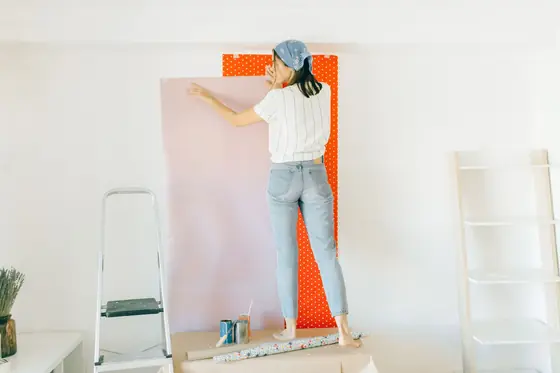
Feature walls in later houses
Plaster in a 1970s house is generally flat enough for a modern non-woven paper hung straight onto a sized wall. A popular choice is one wall in a living room or bedroom picked out in a bold pattern, which gives the room a focal point without papering all four sides.
Owners without a mortgage make up 36.9% of St Ives households. When a house is paid off, decorating tends to be planned for the long term, and paper suits that. Simon, our specialist, handles grasscloths, flocks and hand-printed designs, and we hold samples up in the room so you can judge the scale first.
Older and listed walls in the town
The pre-1900 houses, about 440 of them in Council Tax records, may have lime plaster that has been patched over generations. Lining paper evens those walls out before the finish paper goes on. When stripping reveals tired lath and plaster, we stop and agree a fix, as in this Cambridge bedroom we stripped and skimmed. For listed interiors, Huntingdonshire District Council can advise whether removing old finishes needs consent.
St Ives at a glance
- 18 milesby road from our Landbeach base, about 24 minutesOSRM routing
- 7%of properties were built before 1919VOA Council Tax stock
- 3%date from 1919 to 1939VOA Council Tax stock
- 7,522householdsCensus 2021
- 152listed buildingsHistoric England
- 67%of homes are owner-occupiedCensus 2021
How we approach wallpapering
We strip old paper, wash off paste, fill and size the wall, then plan the repeat from the focal point outward. On older St Ives plaster we hang lining paper first and let it dry. Each drop is checked against a plumb line, joins are rolled flat, and paste is wiped off the face before it can mark. The full method, products and FAQs are on our wallpapering page.