
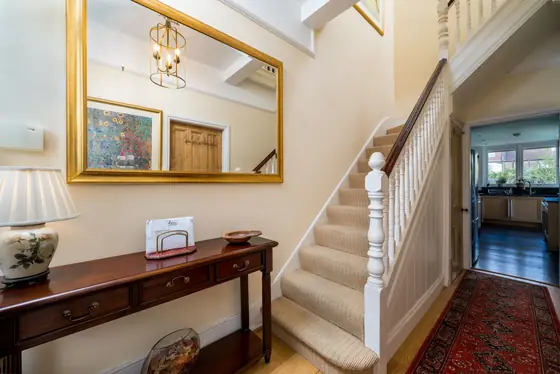
Refreshing doors and skirtings in later houses
A three-bedroom home, the type 40.8% of St Ives households live in, has plenty of internal doors and a lot of skirting. Old gloss is sanded to give the new coat something to grip, joints and gaps along the wall are filled, and many owners now choose satin or eggshell instead of high gloss.
Painting skirtings and doors in the wall colour, or a shade darker, is a quiet way to make a room feel calmer. Bare pine is primed with Zinsser so knots don't bleed through.
Stairs, beams and period joinery
Stained staircases need even sanding so the colour takes without blotches, then a clear protective coat on the treads and handrail. St Ives has 147 Grade II listed buildings, and joinery in those may be original, so we take the gentler route and test finishes on a hidden area. Beams and worktops are finished in Osmo oil, as at the Fulbourn conversion.
St Ives at a glance
- 18 milesby road from our Landbeach base, about 24 minutesOSRM routing
- 7%of properties were built before 1919VOA Council Tax stock
- 3%date from 1919 to 1939VOA Council Tax stock
- 85%are houses rather than flatsCensus 2021
- 152listed buildingsHistoric England
- 67%of homes are owner-occupiedCensus 2021
How we approach woodwork staining & varnishing
We clean grease and polish off doors and skirtings, sand lightly, and fill dents, open joints and gaps along the wall. For stain, the timber is sanded evenly and the colour tested on the back of a door or underside of a tread. Panelled doors are worked panels first, then rails and stiles, so wet edges never overlap. The full method, products and FAQs are on our woodwork staining & varnishing page.