
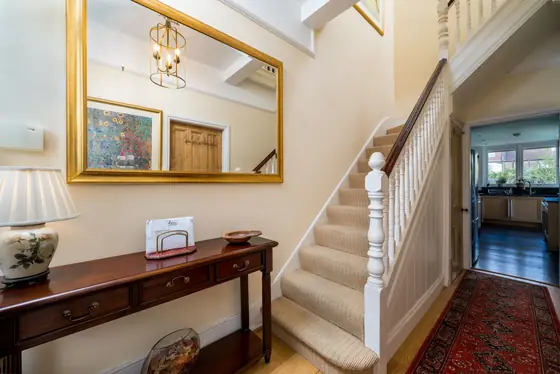
Staircases and doors in newer Papworth homes
Where a staircase was finished in clear varnish when the house was built, that varnish yellows and wears through on the treads and handrail. We can sand it back and restain or revarnish, or prime and paint the spindles and strings while staining the handrail and treads for contrast.
Internal doors get the same choice. In Fordham, Valter and Denes stained a staircase and doors for Mrs M Turner, who praised the staining in her review. You can read others on our reviews page.
Varnishing, staining and painting skirtings and trim
Bare or thinly painted softwood bleeds resin from its knots, which shows as yellow-brown patches. We seal knots and prime with Zinsser before undercoat and top coats. Gloss gives a hard, wipeable surface, while satin and eggshell look softer and hide dents better.
Papworth also has six listed buildings and a conservation area, and older homes may have panelled doors and deeper skirtings. On those we make good dents and old drips before refinishing, and oak or beams can be finished in Osmo oil. More on our staining and varnishing page.
Papworth Everard at a glance
- 20 milesby road from our Landbeach base, about 25 minutesOSRM routing
- 4%of properties were built before 1919VOA Council Tax stock
- 6%date from 1919 to 1939VOA Council Tax stock
- 90%are houses rather than flatsCensus 2021
- 6listed buildingsHistoric England
- 62%of homes are owner-occupiedCensus 2021
How we approach woodwork staining & varnishing
We start by testing the stain or paint on a hidden spot, since newer softwood and older timber take colour differently. Treads, spindles and rails are sanded by hand and with dust-free sanders, knots sealed and bare wood primed. A route up and down the stairs is agreed with you, and treads and handrails get a clear protective coat after staining. The full method, products and FAQs are on our woodwork staining & varnishing page.